
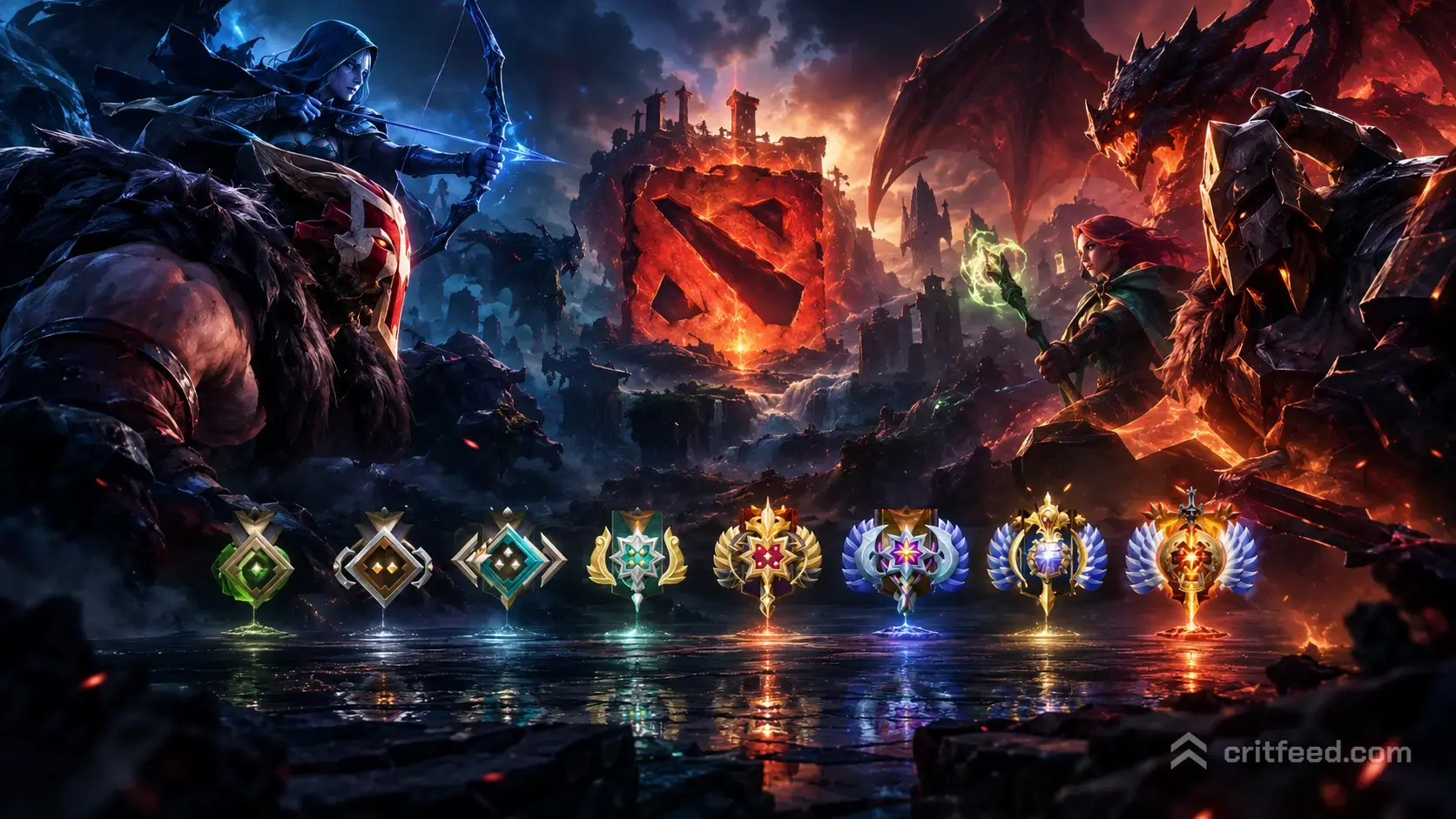
If you have ever stared at your medal after a rough loss and wondered how the number under it actually works, this Dota 2 MMR guide is for you. We will break down how Matchmaking Rating works, what Rank Confidence really does, how the medal tiers relate to your rating, and the habits that actually help you climb. No fluff just the mechanics and the plays that separate a stuck Archon from a climbing Legend.
What Is MMR in Dota 2?
Matchmaking Rating (MMR) is the rating Valve uses to estimate your skill and match you with players around your level. Win a ranked game and your MMR generally goes up. Lose one and it generally drops. Simple in theory, but the amount it moves can vary.
Dota 2’s current matchmaking system also uses Rank Confidence, which represents how certain the system is about your current rating. When confidence is lower, your rating can move more dramatically as the system gathers more information about your skill. As confidence becomes more stable, your MMR changes tend to become more consistent.
Your MMR is represented by a rank medal ranging from Herald through Immortal. The exact MMR boundaries associated with medals can change over time, so fixed numbers should not be treated as permanent rules.
The Dota 2 Rank Tiers Explained
Dota 2’s ranked ladder has eight main tiers:
| Rank | Stars |
|---|---|
| Herald | 1–5 |
| Guardian | 1–5 |
| Crusader | 1–5 |
| Archon | 1–5 |
| Legend | 1–5 |
| Ancient | 1–5 |
| Divine | 1–5 |
| Immortal | Leaderboard-based |
The first seven tiers use five stars to show progression within the medal. Immortal works differently, with players at the top end represented through the Immortal leaderboard rather than a normal five-star medal progression.
Rather than relying on a permanent MMR table, use the current in-game medal and MMR display as the authoritative reference. Older Dota 2 rank guides often publish fixed thresholds, but those numbers can become outdated as Valve changes the ranking system and distribution.
Want the full visual breakdown of every medal? Our Dota 2 ranks guide covers each tier with player-percentage context.
Rank Confidence: Why Your MMR Moves Differently
Rank Confidence is one of the most important parts of understanding modern Dota 2 MMR.
Think of it as the system’s confidence in its estimate of your current skill:
- Lower confidence: Your MMR can move more aggressively while the system gathers information.
- Higher confidence: Your rating tends to move in a more stable and predictable way.
- Long periods away from ranked play: Your confidence can fall, meaning your first games back may have a larger impact.
This is why two players can win a ranked game and see different MMR changes. The system is not simply applying one permanent number to every player in every match. Rank Confidence is part of the calculation.
The important takeaway is simple: do not assume every ranked win is worth exactly the same amount of MMR.
One MMR, Multiple Roles
Dota 2’s older ranked system used separate Core and Support MMR values, but that is no longer the best way to describe the current system. Modern Dota 2 uses a unified MMR rather than maintaining separate ranked ratings for Core and Support roles.
That means:
- Playing Position 1 can affect the same overall MMR as playing Position 5.
- Switching roles does not mean you are playing on a completely separate MMR.
- Your role choice still matters for matchmaking and gameplay, but it does not create a separate Core or Support medal.
So if you have been following an older guide that says you can be Divine Support and Ancient Core because of two separate MMR values, that information is outdated.
Calibration: How Dota 2 Determines Your Rank
One of the biggest misconceptions about Dota 2 calibration is that everyone simply plays 10 ranked games and receives a medal.
The current system is built around Rank Confidence, rather than a permanently fixed 10-game calibration process. Players need to build enough confidence for the game to reveal their ranked rating and medal. A commonly used calibration threshold is 30% Rank Confidence.
Before ranked matchmaking is available on a new account, Valve also requires a significant amount of prior playtime; the current requirement is 100 hours.
During calibration:
- Your Rank Confidence is low because the system has limited information about your ranked performance.
- Your results help the system refine its estimate of your skill.
- MMR can move more dramatically while confidence is low.
- Calibration can take a different number of games depending on how quickly your confidence increases.
Practical tip: Do not treat calibration as a lottery. Play your strongest heroes, avoid experimenting with unfamiliar roles, and focus on winning rather than trying to inflate your personal stats.
Immortal and the Dota 2 Leaderboard
At the highest level, Dota 2 uses regional leaderboards to rank Immortal players.
Valve currently lists four leaderboard divisions:
- Americas
- Europe
- Southeast Asia
- China
To qualify for the leaderboard, Valve currently requires at least 300 lifetime matchmade games, 100 lifetime ranked games, and 14 calibrated ranked games in the same division during the previous 21 days. The leaderboards are updated hourly.
Your leaderboard division is based on where you have played the most ranked games during that recent period. Valve also notes that MMR scales differ between divisions, so comparing raw MMR numbers across regions is not necessarily meaningful.
This is different from saying that Divine and Immortal players simply lose a fixed amount of MMR every week. Avoid treating inactivity as a universal weekly MMR decay rule. Rank Confidence and leaderboard eligibility are the safer way to explain what happens when high-level players stop playing.
How Much MMR Do You Gain or Lose Per Game?
There is no single fixed MMR number that applies to every ranked game.
A win normally increases your rating and a loss normally decreases it, but the amount can vary depending on factors including your rating and Rank Confidence. Players with lower confidence can experience larger swings than players whose ratings are already well established.
So while you may often see numbers around the familiar 20–30 MMR range in normal games, it is better not to present 25–30 MMR as a guaranteed rule.
The practical lesson is more useful than the exact number:
Do not judge your progress from one match. Judge it over a large sample of games.
How to Actually Climb: A Practical Framework
Every rank has a wall. Herald players struggle with last-hitting. Archons throw 25-minute leads. Ancients tilt when a lane goes wrong. Here is what actually breaks those walls.
1. Pick a Small Hero Pool
Two or three heroes per role. That is it. Mastery beats variety at every bracket below Immortal. Not sure where to start? Our Dota 2 hero tier list shows which heroes reward practice most right now, and Dota 2 best heroes for beginners is a cleaner starting point if you are new to a role.
2. Win the Laning Stage First
The first 10 minutes can have a huge influence on how easily your team can play the rest of the map. Last hits, denies, harass timing, pulls, creep equilibrium, and rune control all matter.
You do not need to win the lane by 10 kills. You need to come out of it with a better position for the next phase of the game. Our Dota 2 laning guide walks through the exact patterns.
3. Ward Like You Mean It
Vision wins fights before they start. Two well-placed observer wards around important areas of the enemy jungle can create opportunities that raw mechanics cannot.
Study proper Dota 2 warding spots for both offensive and defensive maps, and start placing vision based on what your team actually wants to do next.
4. Learn the Map, Not Just Your Lane
Roshan timings, rune spawns, camp stack windows, jungle rotations, teleport locations, and objective timing are all part of climbing.
If the map itself still feels unfamiliar, start with our Dota 2 map guide.
5. Buy Items on Purpose
Building the same “core items” every game is how players get stuck.
Read the game. Do you need to break high ground, kill a slippery carry, survive burst, dispel an important debuff, or save an ally?
Our Dota 2 item guide covers the decision-making, and neutrals matter more than most players realize; the Dota 2 neutral items guide fills that gap.
6. If You Play Support, Play Support Well
Supports can have enormous influence over the early and mid game. Ward, create opportunities, protect your cores, set up smokes, control vision, and know when to stop taking farm.
Our Dota 2 support guide is built exactly around that.
7. Manage Your Behavior Score
Toxic chat, abandons, and repeated reports can make your overall matchmaking experience worse. Staying calm is not just good sportsmanship it also helps you avoid throwing games because of unnecessary arguments or tilt.
See how the Dota 2 conduct summary works and keep your behavior under control.
Common Mistakes That Cost You MMR
- Queueing tilted. After a couple of frustrating losses, taking a break is often better than immediately queueing again.
- Instalocking a “comfort” hero into a bad matchup. Your draft matters before the horn even sounds.
- Chasing kills you cannot secure. Kill greed can give the enemy carry free space and waste your team’s advantage.
- Refusing to buy defensive items. BKB, Glimmer Cape, Force Staff and Lotus Orb can completely change how a fight plays out when they solve the right problem.
- Ignoring your settings. Input lag, unstable FPS, and poor visibility can make fights harder than they need to be. Our Dota 2 best settings breakdown can help you clean up your setup.
Solo Queue vs Party Queue
You can climb through both solo and party matchmaking, but playing with friends introduces different matchmaking variables and coordination between the two teams.
The important thing is not to assume that party games automatically give you less MMR. The result of the match and the matchmaking system’s rating calculations matter more than a simple “solo gives 30, party gives 20” rule.
If your goal is to focus entirely on improving your individual decision-making, solo queue can make that easier. If you prefer playing with friends, party queue is perfectly viable just make sure everyone is focused on winning rather than blaming each other.
The Bottom Line
Your Dota 2 MMR is a rating used to estimate your skill, while Rank Confidence tells the system how certain it is about that estimate. Lower confidence can mean larger rating swings, while a more established rating tends to move more consistently. The ranked ladder runs from Herald through Immortal, with the highest players represented through regional leaderboards.
Do not obsess over whether one win gave you 24, 27, or 31 MMR. The mechanics are designed to move your rating toward the level the system believes matches your performance.
The part you can control is much simpler: pick a small hero pool, improve your laning, control vision, make better item decisions, communicate without tilting, and learn from your losses.
Ready to go deeper? Pair this guide with our Dota 2 best carry heroes breakdown if you main Position 1, or the Dota 2 best support heroes list if you live in the 4 and 5 slots.