
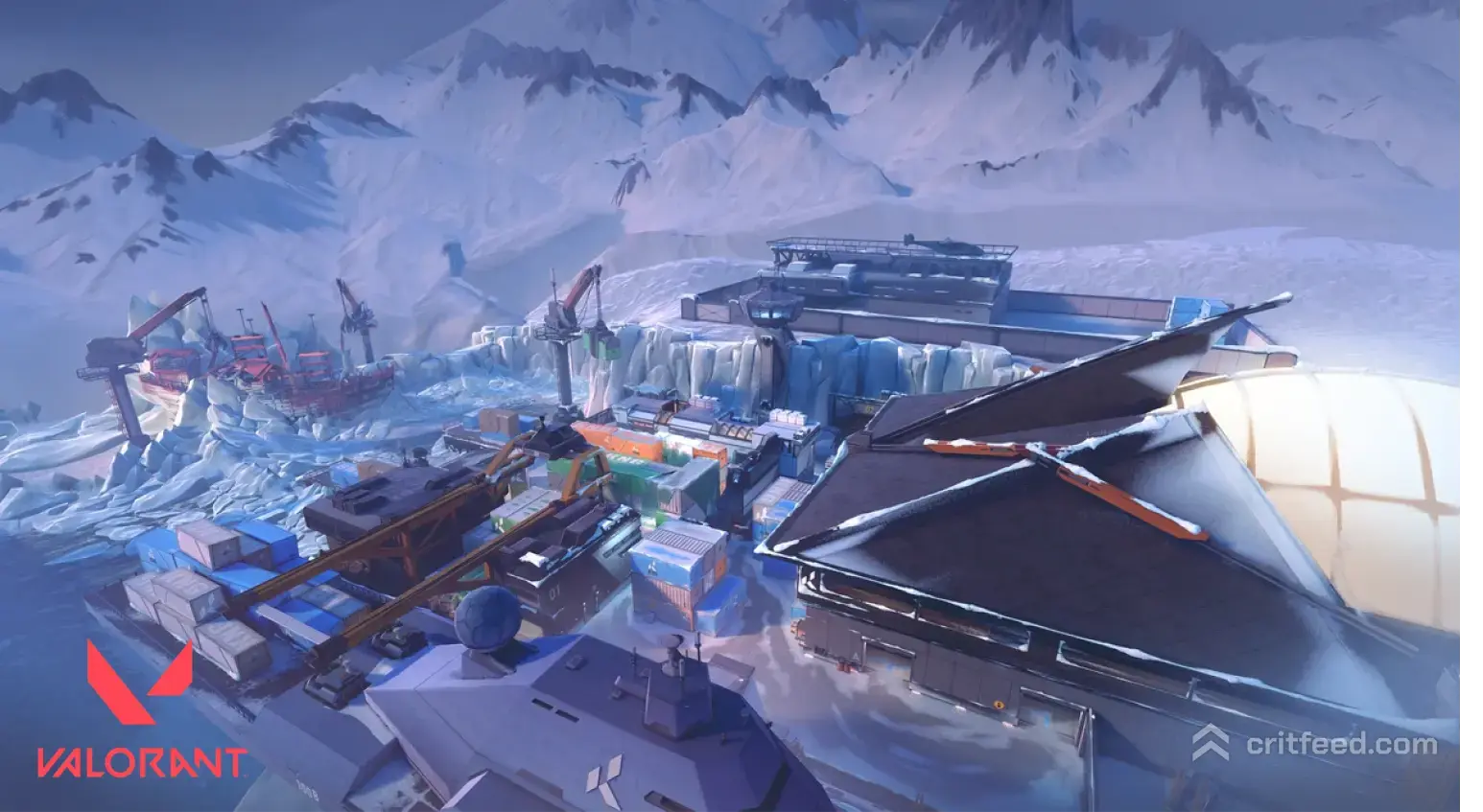
The Valorant Icebox map is the frozen, vertical playground that splits the community into lovers and haters. Set at a secret Kingdom Corporation research base in Russia, Icebox trades wide angles for tight chokes, ziplines, and ropes that reward players who can hold crosshair placement at head level while thinking in three dimensions.
We built this guide to cut through the noise. Below, you will find the exact callouts, site breakdowns, agent picks, and round-by-round tactics that actually move win rate on Icebox.
Icebox Map Overview
Icebox is a two-site bomb defusal map with a heavy vertical layout. The A site sits in the open on a shipping yard with tall crates and construction scaffolding, while B site is tucked inside a warehouse with tight corners and a green tube that funnels attackers into a single choke.
The core identity of Icebox:
- Two bomb sites (A and B) with strong crossfires
- Ziplines connecting A Site and A Nest
- Ropes (ascenders) that let you climb quickly onto high ground
- Multiple stacked angles that reward operators and off-angles
- A rotate-heavy mid area that neither team can fully control
If you are just getting started with the game, our valorant beginners guide covers the fundamentals you should lock in before diving into a map this complex.
Icebox Callouts You Must Know
Callouts are how you win rounds without a scoreboard read. Icebox has some of the trickiest naming conventions in the pool because of its verticality.
A Site Callouts
- A Site (the main plant area with the yellow shipping container)
- A Rafters (elevated wooden platform above default plant)
- A Screens (the digital signage area near the containers)
- A Nest (raised sniper position with a zipline)
- A Belt / Tube (the yellow conveyor tube near mid)
- A Pipes (the industrial pipes on the attacker side)
- A Kitchen (attacker-side room leading toward A main)
- A Ramp (defender ramp connecting spawn to A)
B Site Callouts
- B Site (the main plant with the ascender in the middle)
- B Green (the green shipping container attackers push through)
- B Yellow (the yellow container on site used for cover)
- B Snowman (the small snowman in the back corner)
- B Tube / Orange (the orange tube leading to site)
- B Kitchen (defender-side utility room)
- Boiler (deep-lurk area behind B site)
Mid and Rotate Callouts
- Mid Bottom (low ground under the mid pit)
- Mid Boiler / Cubby (defender-side entry to mid)
- Mid Backsite (the connector between mid and B)
Ultimate Orbs on Icebox
Icebox has two Ultimate Orbs, one on each side of the map:
- A Orb: sits near A Kitchen, giving attackers easy access early round
- B Orb: located near B Tube, contested by defenders pushing kitchen
Grabbing an orb every round or two is a huge tempo boost, especially for controllers and initiators.
Icebox Attack Strategy
Attacking Icebox is a puzzle. Space is tight, defender crossfires are brutal, and post-plants often decide the round before the Spike is even down.
Take Map Control Early
The first 20 seconds of a round on Icebox should almost never be a full commit. Instead:
- Send a controller to smoke off key angles (A Screens, A Rafters, or B Tube).
- Use a duelist to clear close corners rather than lurk long angles.
- Grab the Ultimate Orb whenever a lurker or flex can safely rotate.
Executing A Site
A site is a nightmare for defenders once smokes go down. Focus your utility on:
- A Screens smoke to block the CT sniper angle
- A Rafters smoke or wall to shut down elevated defenders
- A Nest denial using a Sova Recon Bolt or KAY/O’s ZERO/point
Once the site is smoked, planting default (behind yellow container) gives you the best post-plant angles from A Belt and A Tube.
Executing B Site
B is a much tighter execute. You want to funnel through B Green with utility stacked:
- Molly or wall the ascender to stop defender re-peeks
- Smoke Kitchen and Orange to isolate site defenders
- Plant default or deep depending on your post-plant crossfire
Key tip: Never plant B site in the open without checking the ascender. Defenders drop onto site constantly.
Icebox Defense Strategy
Defense on Icebox is about holding angles the attackers cannot pre-fire cleanly. That means off-angles, elevated positions, and quick rotates through mid backsite.
Defending A Site
- A Rafters and A Screens form a natural crossfire. One player up top, one behind screens.
- A Nest with an operator is one of the strongest angles in the game if you get the first shot.
- Fall back to default and use the yellow container for retake cover.
Defending B Site
- Hold from Yellow or Snowman for close-range trades.
- One player on the ascender can drop down for retakes or hold Kitchen.
- Boiler is a strong lurk trap if you know the enemy loves to swing wide.
For more general angle-holding fundamentals, our valorant tips and tricks breakdown pairs well with this section.
Best Agents for Icebox
Not every agent thrives on Icebox. The map rewards smokes with wide coverage, initiators with vertical scans, and sentinels who can lock down cramped sites.
| Role | Top Picks | Why They Work |
|---|---|---|
| Controller | Viper, Harbor | Viper’s wall splits both sites, Harbor’s utility covers ziplines |
| Duelist | Jett, Reyna, Raze | Jett’s dash and updraft abuse verticality, Raze’s satchels reach high ground |
| Initiator | Sova, KAY/O, Skye | Recon and flashes clear stacked angles fast |
| Sentinel | Killjoy, Chamber, Sage | Sage’s wall on B ascender is iconic, Killjoy locks down cramped B |
Viper is nearly a must-pick. Her wall bisects both sites cleanly and turns post-plants into free rounds. If you play controllers, our valorant omen guide covers when Omen is still viable as an alternative pick on maps like this.
Duelists with mobility crush Icebox because ziplines and ropes create so many jiggle-peek opportunities. If you main a fast entry agent, neon valorant tips covers how her slide and stun translate to tight sites like B.
Icebox Zipline and Rope Tips
The ziplines and ropes are the signature feature of Icebox. Use them, but use them smart.
- You can shoot while riding a zipline, but you are an easy target. Only ride when smoked or flashed.
- You can drop off ziplines mid-ride by pressing the crouch key.
- Ascenders (ropes) can be used silently by walking into them at slow speed to avoid making noise.
- Defenders can pre-aim zipline exits, so vary your entry timing every round.
Post-Plant Positions That Win Rounds
Post-plant is where Icebox rounds are won or lost. Here are the strongest spots.
A Site Post-Plant
- A Tube / Belt for a wide angle onto site
- A Rafters if you can climb up safely
- A Kitchen crossfire with a teammate on Belt
B Site Post-Plant
- B Green corner for a fast peek and retreat
- On top of the ascender for elevated post-plant control
- Boiler lurk to catch late rotators
Common Icebox Mistakes to Avoid
We see the same errors ruin rounds in ranked over and over. Fix these first.
- Riding ziplines without utility. You die every time.
- Planting in the open on B site without checking the ascender.
- Ignoring the Ultimate Orb on eco rounds.
- Peeking A Rafters without a flash. The defender always wins that trade.
- Not rotating through mid backsite. It is the fastest rotate on the map.
For a broader look at how Icebox fits into the rest of the pool, check our full valorant maps overview. If you want to compare it to another vertical map, our split valorant map guide is a great next read.
The Bottom Line
Icebox is a map of angles, verticality, and utility usage. Attackers who commit to a site with full smokes and mollies punch through. Defenders who hold off-angles and rotate through mid punish rushes hard.
Master the callouts, pick the right agent, and stop riding ziplines naked. That alone will move your Icebox win rate up in Competitive.
Ready to climb? Pair this guide with our full valorant tips and tricks and start practicing lineups in a custom game before your next ranked queue.