
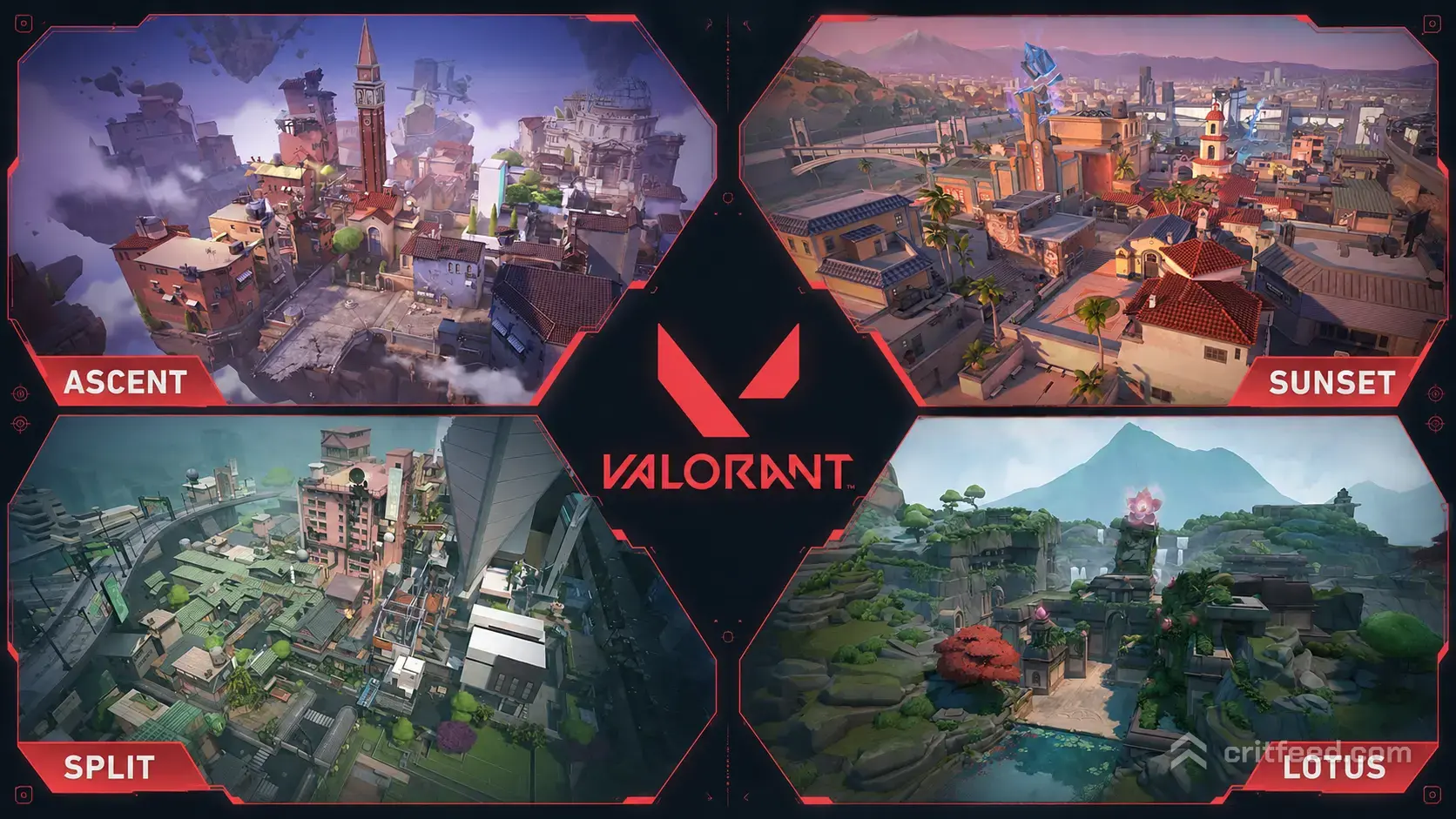
Knowing the Valorant maps inside and out is the fastest way to climb ranks, because every fight, lineup, and rotation starts with map knowledge. Riot Games has built a diverse pool of battlegrounds each with unique gimmicks, from teleporters to ropes to moving trains and mastering them separates good players from great ones.
This guide breaks down every map, its layout, its quirks, and how to play it. Whether you main duelists or hold angles as a sentinel, you’ll find what you need here.
How Valorant Maps Work
Every standard map in Valorant follows the same core loop: attackers plant the Spike, defenders stop them or defuse. Most maps feature two bomb sites (A and B), while a few feature three. Rounds last 100 seconds, and the first team to 13 rounds wins (with overtime rules if tied).
What makes each map unique is its signature mechanic a teleporter, a rotating door, a zipline, or something stranger. Learning these features is just as important as learning callouts.
If you’re brand new, start with our valorant beginners guide before diving into map-specific strategy.
The Complete Valorant Map List
Here’s every map that has appeared in Valorant’s competitive rotation, along with its defining feature.
| Map | Sites | Signature Feature |
|---|---|---|
| Bind | A, B | Two one-way teleporters |
| Haven | A, B, C | Three bomb sites |
| Split | A, B | Vertical ropes and tight mid |
| Ascent | A, B | Mechanical mid doors |
| Icebox | A, B | Ziplines and vertical angles |
| Breeze | A, B | Long sightlines, huge sites |
| Fracture | A, B | H-shaped, attackers spawn on both sides |
| Pearl | A, B | Underwater, no gimmicks |
| Lotus | A, B, C | Three sites and rotating doors |
| Sunset | A, B | Los Angeles setting, tight mid |
| Abyss | A, B | No map borders you can fall off |
Two-Site Maps
Bind
Bind’s defining feature is its pair of one-way teleporters one in A Short, one in B Long. Attackers can flank with a loud teleport sound, forcing defenders to guess. There is no traditional mid, so rotations happen through Hookah or Showers, making info-gathering agents like Sova and Cypher extremely strong.
Split
Split lives up to its name with a narrow mid split by ropes and tight corridors. Vertical play matters here: A Heaven, A Rafters, and B Heaven all give elevated angles that punish careless pushes. Smokers like Omen thrive because so many chokes need blocking at once.
For controller mains, our valorant omen guide covers the smokes you need for Split’s mid takes.
Ascent
Ascent is often called the most “classic” Valorant map open mid, two clear sites, and mechanical doors at each site that either team can close. Mid control decides most rounds. A Heaven is one of the strongest post-plant angles in the game.
Icebox
Icebox is a vertical playground. Ziplines at A and B site let attackers hit heaven angles directly, while tight corridors around mid force close-range duels. It rewards aggressive duelists and mechanical aim over utility dumps.
Breeze
Breeze is the longest-range map in the pool. Massive open sites, huge sightlines, and a tunnel connecting mid to A make Operator picks like Chamber and Jett dominant. Smoke coverage is critical without a good controller, attackers get picked off from three angles at once.
Fracture
Fracture is shaped like an “H,” with attackers spawning on both sides of defenders. Ziplines let attackers swing between halves quickly, but defenders can rotate through a central hallway. Initiators like Breach and Fade shine because of the many tight chokes.
Pearl
Pearl is deliberately gimmick-free no teleporters, no ziplines, no ropes. It’s a pure gunfight and utility map with a strong mid that funnels most action. Mid control almost guarantees a favorable round on either side.
Sunset
Sunset takes players to a Los Angeles neighborhood with a tight mid divided by a courtyard. A site has strong post-plant lineups from A Elbow, while B is a close-quarters brawl through Market. Duelists with quick entry tools do well here.
Abyss
Abyss is Valorant’s most experimental map: it has no map borders. Fall off the edge and you die instantly, which changes how utility, movement, and even flashes work. Knockback abilities like Neon’s Fast Lane and Fade’s Seize become deadly.
Speaking of Neon, our neon valorant guide covers how to abuse her speed on Abyss and Sunset.
Three-Site Maps
Haven
Haven is the original three-site map. With A, B, and C sites, defenders are stretched thin, and fast rotations decide rounds. Attackers can fake one site and swing to another before defenders reset. Sentinels like Killjoy and Cypher are essential because a single player often has to hold a site alone.
Lotus
Lotus is the second three-site map and features rotating doors between A and C, plus a breakable wall in mid. Sound plays a huge role those doors are loud, and defenders can bait attackers by triggering them. It’s a map that rewards patient, coordinated play.
Map-Specific Tips That Actually Help
- Learn one map at a time. Trying to memorize every callout on every map at once leads to burnout. Pick your ranked queue’s most common map and drill it.
- Watch the minimap during warmups. Custom games let you walk the entire map. Do this once per map to lock in orientation.
- Practice utility lineups in range. Every map has 5–10 “must-know” lineups per site. Learn them from your main agents.
- Study pro VOD rotations. VCT teams show the fastest rotation paths and defensive setups for each map.
For more habits that translate across every map, check our valorant tips and tricks breakdown.
Which Maps Are in the Current Rotation?
Riot rotates maps in and out of the Competitive queue regularly to keep the meta fresh. Maps not in the active rotation still appear in Unrated, Swiftplay, and Custom Games, so you can practice them any time.
We recommend checking the latest valorant patch notes for the current active map pool, since it changes with every major update and we won’t list a rotation here that could be out of date by the time you read this.
The Bottom Line
Valorant’s map pool is one of the most varied in tactical shooters, with each map demanding a different composition and playstyle. Learn the signature mechanic first, then the callouts, then the lineups in that order. Master three maps deeply before trying to learn all of them, and your ranked win rate will climb faster than trying to be average on everything.
Ready to lock in? Pick your favorite map from the list, hop into a Custom Game, and start walking sites. Every hour you spend in an empty server pays off in ranked.