
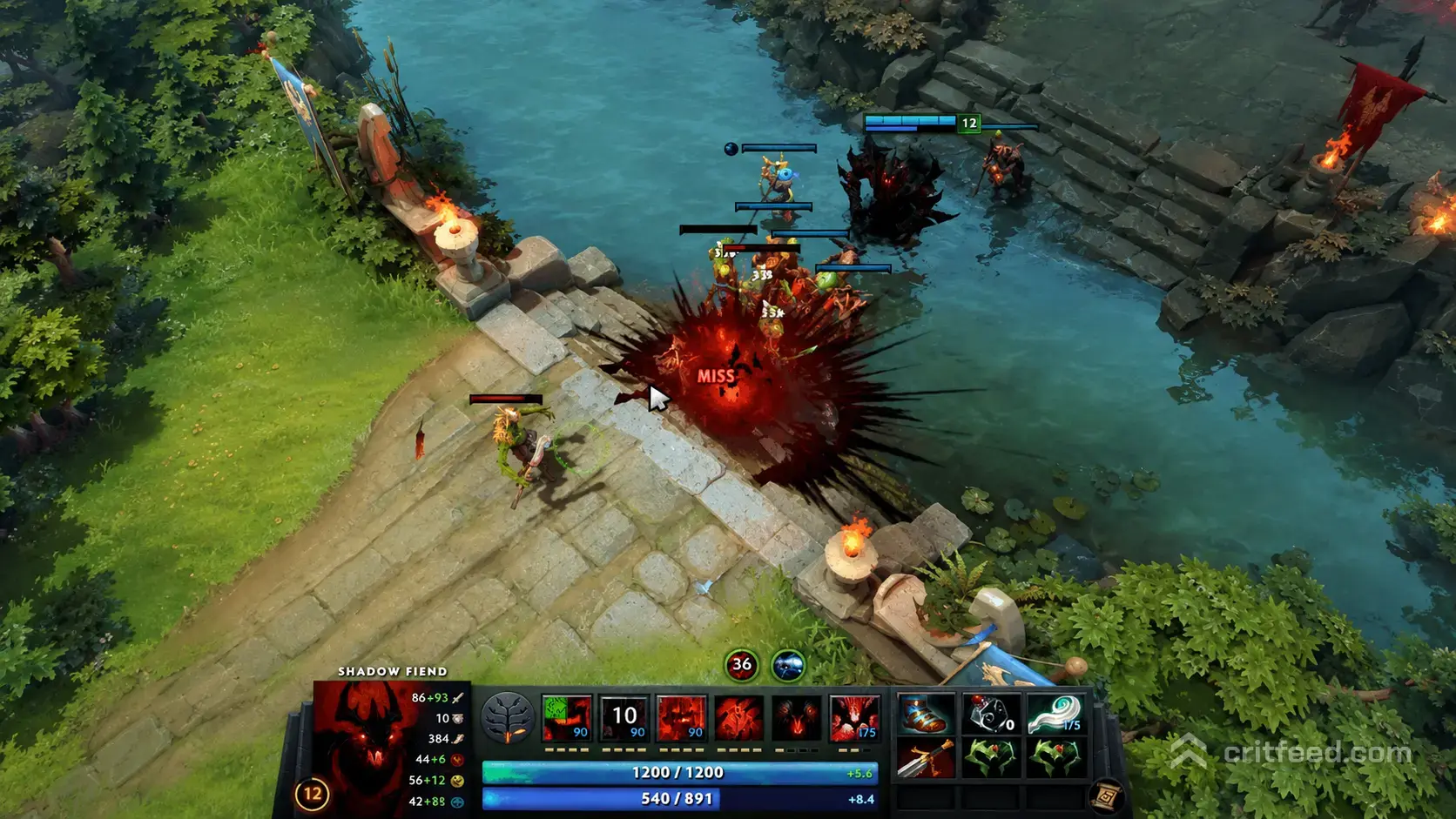
If your team ever walked up the ramp with a 30k gold lead, whiffed three right-clicks in a row, and got wiped, you already know the Dota 2 high ground miss chance is real. It is one of the oldest mechanics in the game, and it still decides pro matches. This guide breaks down exactly how it works, what ignores it, and how to actually close out games.
What Is the High Ground Miss Chance?
When a unit on lower elevation attacks a unit on higher elevation, its physical attacks have a fixed 25% chance to miss. The miss is rolled per attack and displays “Miss” on the target, exactly like an evasion roll.
This is not evasion in the traditional sense. It is a terrain-based miss that applies to any attacker standing below the target, regardless of hero, item, or level.
Key points to remember:
- The miss chance is 25%, flat, per attack.
- It only triggers when there is an actual elevation difference between attacker and target.
- It applies to creeps, heroes, towers, and even Roshan when the elevation gap exists.
- The high-ground unit gets the benefit. The low-ground unit takes the penalty.
How the Miss Chance Actually Rolls
Dota 2 uses Pseudo-Random Distribution (PRD) for evasion-style rolls to prevent streaks of pure luck. High ground miss chance works the same way. You will not miss five times in a row on average, but you also will not always miss exactly once every four attacks.
The system slightly increases your chance to hit after each miss and slightly decreases it after each successful hit. Over a long fight, it averages out to 25%, but any single skirmish can feel brutal.
What Ignores the High Ground Miss Chance
This is the part every carry player should memorize. Several sources of damage completely bypass the miss chance.
| Source | Affected by 25% Miss? |
|---|---|
| Physical auto-attacks from low ground | Yes |
| Spells and ability damage | No |
| True Strike attacks | No |
| Attacks with vision of the target | No, if vision is on high ground |
| Ranged attacks (no vision) | Yes |
| Damage over time (DoT) | No |
The single most important rule: if you have vision of the high ground, your attacks are not affected by the miss chance. Vision breaks the mechanic entirely.
This is why flying couriers, Observer Wards on the cliffs, and hero abilities that grant vision (like Zeus’s Nimbus or Bounty Hunter’s Track) matter so much during a siege.
Sources of True Strike
True Strike guarantees your attacks land, which means it ignores both evasion and the high ground miss. Some notable sources include:
- Monkey King Bar on ranged heroes (and the built-in True Strike component)
- Bloodthorn’s active on the debuffed target
- Silver Edge first-hit break plus its own True Strike
- Hero abilities that grant guaranteed hits, such as Ursa’s Fury Swipes application, Juggernaut’s Omnislash strikes, and Phantom Assassin’s Phantom Strike attack
If your draft is built to end games on high ground, one of your cores should be able to slot Monkey King Bar or Bloodthorn without ruining their build. We cover buildpaths in more detail in our dota 2 best carry heroes breakdown.
Why Vision Matters More Than Damage
You can be six-slotted and still lose the base if you push up blind. Vision is the actual currency of high ground fights.
Ways to get high-ground vision:
- Observer Wards placed on the T3 cliffs or Rosh pit ledges
- Flying courier parked above the ramp (breaks vision when it dies)
- Zeus ultimate and Nimbus
- Bounty Hunter Track
- Beastmaster Hawk (though it dies fast)
- Buying back a hero already on the high ground
- Smoke pushes that stay on high ground after clearing a wave
Once you have vision, the miss chance disappears and your right-clicks hit like normal. Without vision, even a fed Phantom Assassin will whiff crits into a tower.
We break down the best spots for aggressive vision in our dota 2 warding guide.
Ranged vs. Melee on High Ground
Ranged heroes are not exempt. If a ranged hero on low ground attacks a target on high ground without vision, the 25% miss still applies. Melee heroes rarely deal with this because they have to walk up the ramp anyway, which grants them vision as they climb.
This is why Sniper, Drow Ranger, and Windranger struggle to siege into fog even when they are ahead. Their entire kit is designed around not walking up.
How to Push High Ground Without Getting Wiped
Here is the checklist we run through before every high-ground attempt:
- Wave first. Never take the ramp before a big creep wave (or a mega wave post-barracks push) hits the tower.
- Get vision. Drop at least one Observer and burn a Sentry pair if enemy wards are up. A flying courier parked above works as a backup.
- Buybacks up. At least three players should be able to buy back. If your carry is on cooldown, delay the push.
- Aegis or Cheese. Roshan control usually decides whether you break base. See our dota 2 roshan guide for timing.
- True Strike or spell damage cores. If your damage is entirely physical and you have no vision, expect to whiff.
- Kill before you tower dive. Pick off one hero at the ramp before committing bodies past the tier 3.
Positions That Break the Miss Mechanic
Some positions are naturally better at cracking bases because their damage does not rely on right-clicks.
- Position 2 mids like Zeus, Tinker, and Invoker deal spell damage that ignores the mechanic entirely.
- Position 3 offlaners like Timbersaw, Dark Seer, and Underlord push waves and deal magical damage without needing vision.
- Position 4 and 5 supports provide vision, save cores from dive attempts, and often carry Force Staff or Glimmer Cape to keep the push alive.
If you are shot-calling a game where you have a lead but no way to break, drafting is the real answer. Our dota 2 hero tier list shows which heroes are currently strong in siege compositions.
Defending From High Ground
The mechanic works both ways. When you are defending, the terrain is doing 25% of the work for you.
Defender tips:
- Deny vision aggressively. Sentry every ward spot near your base. Kill couriers that scout the ramp.
- Fight in the fog. Bait attackers to commit before you engage. Every attack they take without vision has a 25% chance to whiff.
- Use fog abilities. Blink Dagger initiations from Enigma, Magnus, or Tidehunter are devastating because the enemy cannot see them charging.
- Buy back for the base, not the fight. If you die on your high ground, buyback is almost always worth it. Losing the base loses the game.
For more on defensive positioning, check our dota 2 map guide.
Common Myths About the Mechanic
“Backdoor protection also gives miss chance.” No. Backdoor protection is a separate system that regenerates buildings when no allied creeps are nearby. It has nothing to do with the 25% miss.
“Evasion and high ground miss stack multiplicatively into 50%.” They stack multiplicatively, not additively. A hero with 25% evasion attacked from low ground has a total miss chance of 1 – (0.75 × 0.75) = 43.75%, not 50%.
“True Strike from an item ignores everything.” True Strike ignores evasion and high ground miss, but it does not ignore Break, blind effects that reduce accuracy through debuffs like Smoke Screen, or fog-of-war targeting issues.
The Bottom Line
The Dota 2 high ground miss chance is a flat 25% penalty applied to physical attacks made from lower elevation against targets on higher ground, and it uses PRD like other miss rolls. The mechanic is bypassed by vision, spell damage, and True Strike sources like Monkey King Bar and Bloodthorn.
If you are losing games with a lead, the problem is almost never damage. It is vision, wave control, and buyback timing. Fix those three and the miss chance stops mattering.
Want to keep climbing? Pair this with our dota 2 mmr guide and start winning the games you should be winning.