
Entry Success Rate Valorant: What ESR Means and How to Raise Yours
If you have ever seen “ESR” on a stat tracker and wondered what it was judging you on, this is the stat. Entry success rate valorant players care about is simply how often the first player into a site wins that opening duel. It is one of the cleanest numbers for measuring entry fraggers like Jett, Raze, Neon and Phoenix mains.
In this guide we break down how ESR is calculated, what counts as a good score, why pros obsess over it, and the concrete habits that push your number up.
What Is Entry Success Rate (ESR) in Valorant?
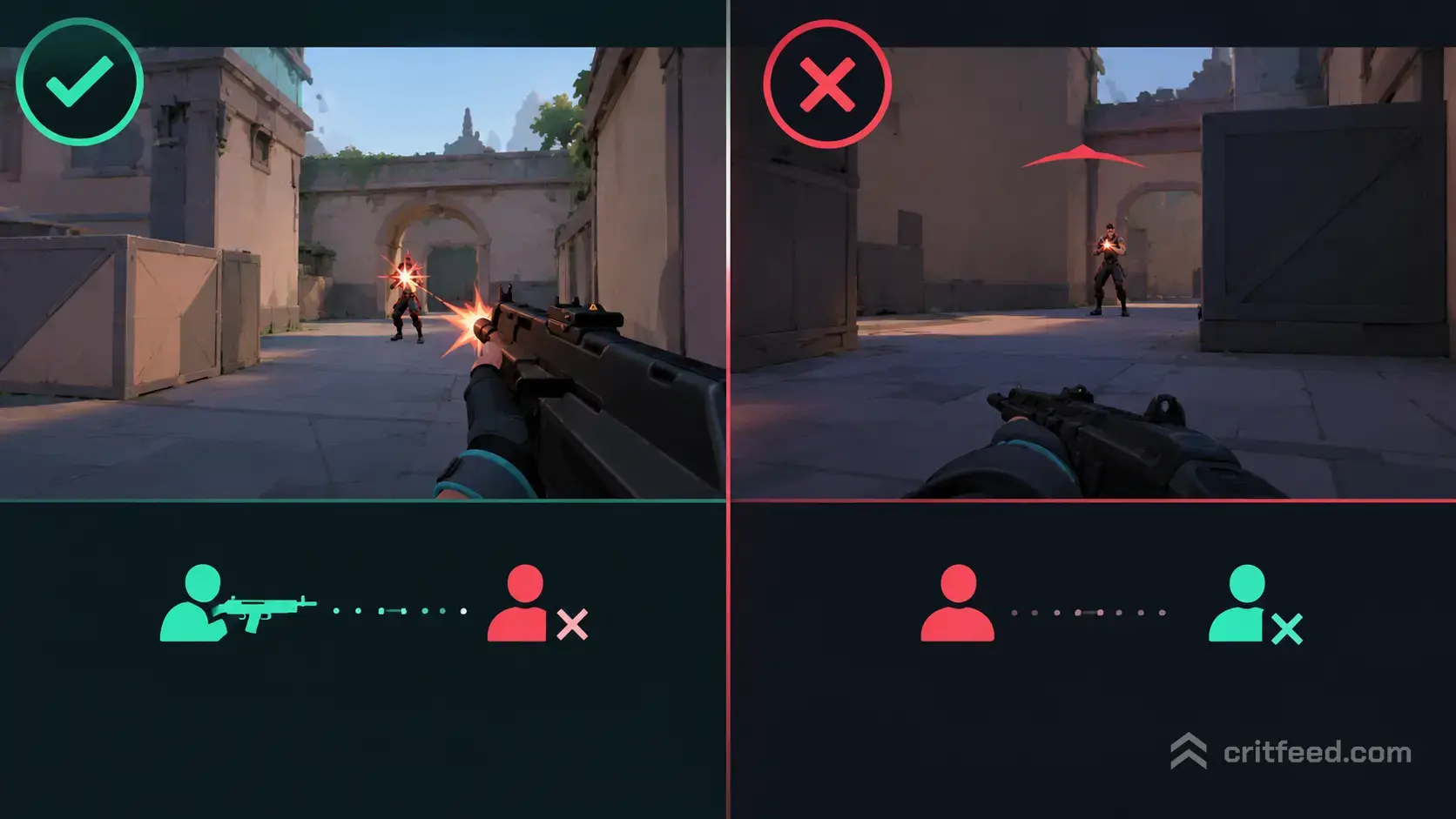
Entry Success Rate (ESR) is the percentage of first-contact duels your team wins when attacking or re-taking a site. It is a measurement of the opening pick, nothing more.
The idea is borrowed from CS-era statistics but has been adapted for Valorant’s agent-driven playstyle. Instead of tracking every kill a player gets, ESR isolates the single most pressure-filled moment of a round: the first gunfight at a contested chokepoint.
If you walk through A Main on Ascent, swing the Heaven angle, and drop the defender, that’s a successful entry. If you die, that is a failed one.
The Simple Formula
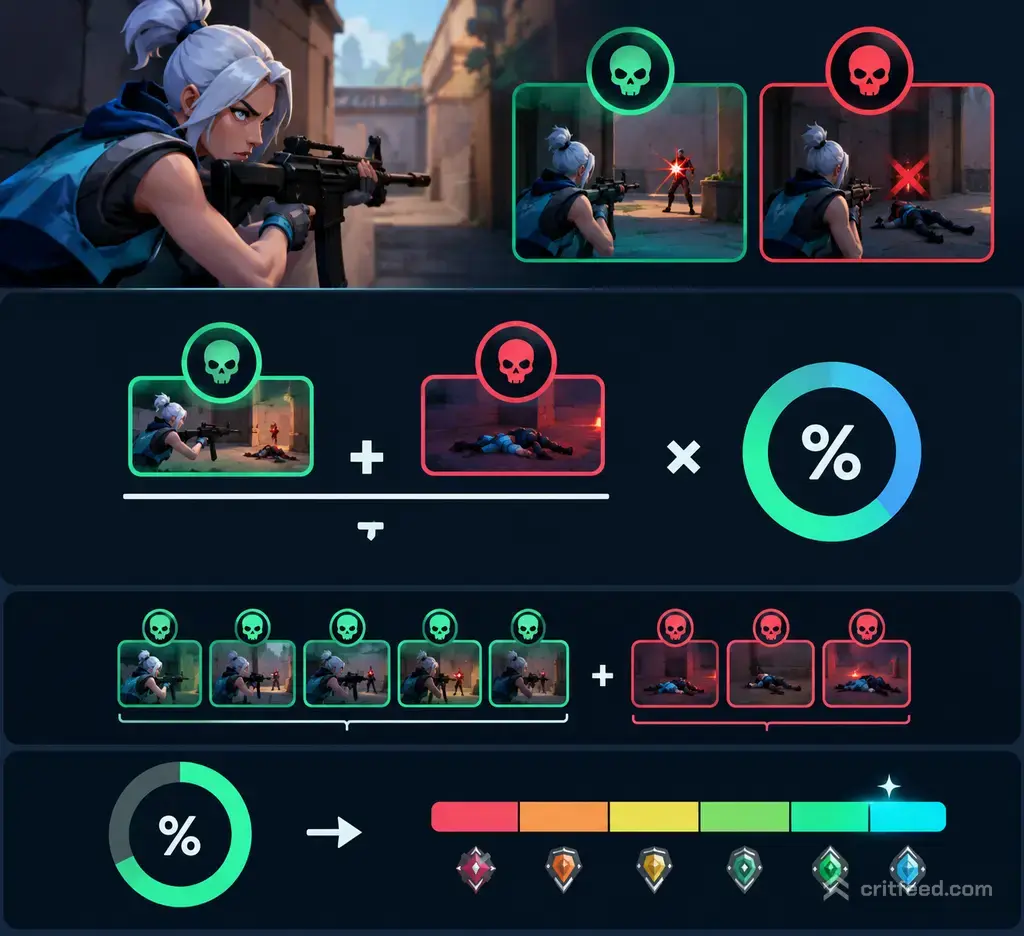
ESR is calculated with a basic ratio:
ESR = (Successful First Duels / Total First Duels Attempted) × 100A player who takes 10 opening duels and wins 6 of them finishes the match at 60% ESR.
Trackers that surface this stat only count rounds where you were genuinely the first player trading shots, not rounds where a teammate pushed ahead of you.
Why ESR Matters More Than Raw Kills
Raw kill counts can mislead. A player can pad an ACS score with easy post-plant kills while losing every opener their team actually needed.
ESR cuts through that noise:
- It measures impact at the hardest moment. Winning the first duel typically gives your team a 5v4 and massive map control.
- It separates true entries from clean-up fraggers. A duelist with 25 kills but a 30% ESR is not opening the map.
- It rewards disciplined aggression. The stat punishes forcing bad peeks even if you occasionally hit a highlight.
Pro analysts weigh ESR heavily when scouting duelists because it tracks the exact role those agents are hired to do.
What Counts as a Good Entry Success Rate?
There is no single “pass” number, but these ranges are a solid reference for ranked and semi-pro play:
| ESR % | Tier | What It Means |
|---|---|---|
| Below 40% | Struggling | You are losing more openers than you win. Rework your peeks. |
| 40-50% | Average | Matches most ranked duelists. Room to grow fast. |
| 50-60% | Strong | You are a reliable entry for your team. |
| 60-70% | Elite | Comparable to top VCT duelists over long samples. |
| 70%+ | Outlier | Rare, usually a small-sample inflation unless sustained. |
Keep in mind that ESR fluctuates by map, agent and lobby strength. A 55% ESR on Icebox against stacked defender setups is more impressive than 65% on an open map against solo-queue defenders.
How ESR Is Used in Pro Play and Scouting
Coaches use entry success rate the way football analysts use expected goals. It tells you whether a player’s role is actually working, not just whether they finished with flashy numbers.
Three ways teams apply the stat:
- Role evaluation. If a signed duelist carries a 45% ESR across a split, the coach has to ask whether that player should still be the hard entry.
- Map pool decisions. A duelist might sit at 65% ESR on split valorant map but drop to 42% on a more open layout. That shapes vetoes.
- Scrim tracking. Teams log ESR per executed set-play to find which utility combinations are actually opening sites.
Analysts also check “supported” versus “unsupported” entries. An entry taken behind a flash and a smoke should land at a much higher rate than a dry swing, and if it doesn’t, aim or timing is the problem.
How to Improve Your Entry Success Rate
The good news is that ESR is one of the most trainable stats in Valorant. These are the habits that move the number.
1. Stop Taking Dry Peeks
The single biggest ESR killer is swinging a corner with no utility used. Every entry should be supported by at least one piece of team utility, usually two. A smoke to block one angle plus a flash to blind the next one is the baseline.
If your team isn’t throwing utility, call for it before you push, or wait for a different round plan.
2. Learn Common Hold Angles
Every map has a short list of angles defenders hold on each site. Memorize them, pre-aim them, and clear them in the right order.
Default holds change by map, so study each one individually. The valorant icebox map rewards very different peek patterns than a tight site like Pearl B.
3. Use Movement to Win the First Shot
Valorant’s first-bullet accuracy rewards clean strafe-stops. Counter-strafe into a wide swing, let the crosshair settle for a frame, then click.
- Keep your crosshair at head level before swinging.
- Jiggle-peek first on close angles to force a flinch or a wasted util.
- Avoid run-and-gunning entries unless the Operator is on the angle.
4. Trade Yourself Out
An entry doesn’t fail just because you die. If you die but your teammate trades the kill within 2-3 seconds, your team still wins the map space. Stay close to a second player so every entry is a guaranteed 1-for-1 at worst.
5. Pick the Right Agent for Your Role
If you want a high ESR, you need an agent built to open sites. Jett’s Updraft and Dash, Raze’s Satchels, and Neon’s slide all exist so you can take fights on your terms. If you main a Sentinel or Smokes agent, don’t expect ESR to be your headline stat.
New players still finding their role can find solid grounding in our valorant beginners guide before chasing advanced stats.
6. Review Your Deaths
After every match, rewatch the rounds where you entried and died. Ask three questions:
- Did I have utility used before I peeked?
- Was I trading distance with my teammate?
- Did I pre-aim the correct angle?
If the answer to all three is yes and you still died, it was a reasonable risk. If any answer is no, that is your fix.
Common ESR Mistakes to Avoid
Some patterns tank entry rates fast. Watch for these in your own play:
- Peeking the same angle twice in a row. Defenders will have it pre-aimed the second time.
- Entrying with no info. No Sova dart, no Fade prowler, no sound cue. You are guessing.
- Over-committing to a site with lost util. If your flashes and smokes are gone, re-set rather than forcing a 1v3 opener.
- Ignoring economy context. Trying to hero-entry on an eco round into a full-buy defense inflates your death count without giving your team real value.
For broader fundamentals that pair with ESR training, our valorant tips and tricks collection covers crosshair placement, timing and comms in depth.
ESR vs. Other Entry Stats
ESR is not the only entry-focused metric. Here is how it compares to related numbers you might see on trackers:
| Stat | What It Measures | Best Use |
|---|---|---|
| ESR | % of first duels won | Measuring entry duelists |
| First Kills Per Round (FK/R) | Opening kills divided by rounds played | Volume of openings |
| First Deaths Per Round (FD/R) | Opening deaths divided by rounds played | How often you die first |
| +/- First Blood | FK minus FD | Net impact on openers |
A healthy duelist profile shows a high ESR, a positive first-blood differential, and a reasonable FD/R. A duelist with high FK/R but equally high FD/R is trading themselves out, which may or may not fit the team plan.
If you want to understand how these stats feed into your competitive progression, our breakdown of valorant mmr explains what the matchmaker actually weighs behind the scenes.
Tracking Your ESR
Riot’s in-game scoreboard doesn’t display ESR directly. To see it you need a third-party tracker that parses match history and tags first-contact duels.
Most trackers show ESR alongside first-blood counts, trade rates and per-map breakdowns. Pull it up after each session and look for:
- Which maps are dragging your average down.
- Whether your ESR drops on attack or defense (defenders can “entry” on retakes too).
- Whether specific agents are inflating or hiding your real number.
Pair that review with map-specific prep. Learning utility lineups and default angles will move your ESR faster than any aim routine.
The Bottom Line
Entry success rate is the clearest single number for judging how well you open sites in Valorant. Anything above 50% is solid, 60%+ is elite, and the fastest way to climb is to stop taking dry peeks, trade with teammates, and pick agents built for the role.
Track it after every session, pick one map to work on each week, and the number will move. The scoreboard rewards the player who wins the first fight, so make that fight fair before you take it.