
Valorant Hip Fire Guide: When It Works and When It Fails
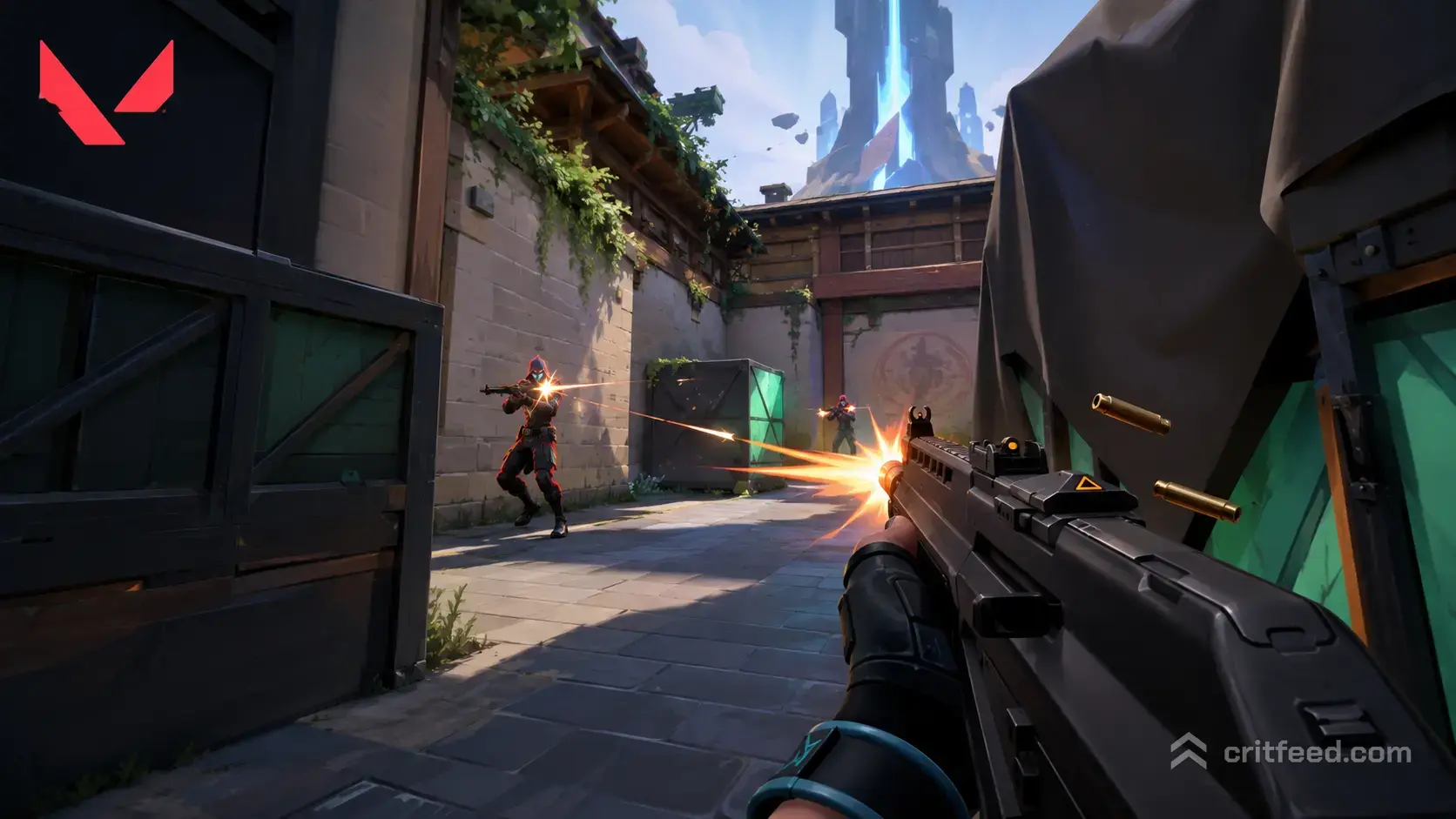
Valorant hip fire is the difference between winning a close-range duel and dying with your scope still zooming in. Shooting from the hip means firing without aiming down sights (ADS), and in Valorant, it is almost always the correct choice at short range. We will break down when to hip fire, which weapons punish you for scoping, and the mechanics that decide whether your bullets go where your crosshair is pointing.
What Hip Fire Actually Means in Valorant
Hip fire is firing your weapon without pressing the right mouse button to ADS. Your crosshair stays open, your field of view stays wide, and your movement speed does not drop as much as it does while scoped.
Every Valorant gun has two accuracy profiles: hip fire and ADS. The gap between the two is different for every weapon, and understanding that gap is the whole point of this guide.
Key takeaway: In Valorant, hip fire is not a last resort. For most rifles and SMGs at close range, it is mechanically better than ADS.
Why Pros Rarely ADS With Rifles
Watch any VCT match and count how often a player ADS with a Vandal or Phantom. The number is close to zero in close-range fights.
Here is why:
- ADS reduces your fire rate on rifles and SMGs. You shoot slower while scoped.
- ADS slows your movement, making you an easier target when strafing out of a peek.
- ADS tightens the first bullet but worsens recoil recovery for follow-up shots on most automatic weapons.
- The hip fire crosshair is already accurate when you are stopped or counter-strafing.
The Vandal and Phantom are built around the first-bullet accuracy of a standing, non-scoped shot. If you are stopped and your crosshair is on the head, you hit the head. Scoping in adds a delay and a movement penalty for no accuracy gain at the ranges most fights happen at.
Weapons Where Hip Fire Is the Default
These guns are designed to be fired without ADS. Scoping with them is almost always a mistake unless the range is unusual.
| Weapon | Hip Fire First Shot | Notes |
|---|---|---|
| Vandal | Highly accurate when stopped | ADS slows fire rate, rarely worth it |
| Phantom | Highly accurate when stopped | Same as Vandal, hip fire is standard |
| Spectre | Good at close range | Only ADS at long distance |
| Judge | Spread stays tight at short range | Never ADS in a close duel |
| Ghost | Pin-point when stopped | Headshot machine without scoping |
| Sheriff | Accurate single tap | ADS is situational only |
The pattern is simple: if the fight is inside 15 meters, your crosshair placement matters more than your scope.
Weapons Where ADS Is Mandatory
Some guns punish you for not using the scope. Hip firing these is a gimmick, not a strategy.
- Operator: Hip fire spread is massive. You scope or you miss.
- Marshal: Same story. The scope exists because the hip fire is unreliable past point-blank.
- Outlaw: Two-shot sniper, both barrels need the scope.
- Guardian: Technically fireable from the hip, but the gun is built for mid-to-long range tap fire with ADS.
- Bulldog (burst mode): Right-click puts it into a scoped burst. Left-click hip fire is a different weapon entirely.
The rule: if the gun has a true zoom scope (not just an ADS pull-in), hip firing wastes the weapon.
Hip Fire Mechanics: Error, Movement, and Recoil
Valorant hides the exact numbers inside the game client, and these values can shift between patches. Check your in-game weapon stats panel for the current figures. The underlying mechanics, however, are stable.
Your Crosshair Lies When You Move
Every weapon has a movement error value. The moment you start moving, your bullets stop going exactly where your crosshair points. They go somewhere inside a cone around it.
Running and shooting in Valorant is almost always a loss. The error cone is wide enough that even a Vandal shot at 10 meters can miss a stationary head.
Counter-Strafing Resets Your Accuracy
Tapping the opposite movement key to cancel momentum returns your weapon to full accuracy in a fraction of a second. This is the single most important mechanical habit for hip fire gunfights.
- Move with A or D to peek.
- Tap the opposite key the instant you see your target.
- Fire while standing still.
This works because Valorant does not require you to be fully stopped visually. It checks your actual velocity. Counter-strafing drops velocity to zero in a tick, and your crosshair becomes trustworthy immediately.
If you want a wider primer on movement habits, our valorant tips and tricks breakdown covers the drills that build this reflex.
Jumping and Shooting
Jump shots in Valorant are not viable. The error applied to a mid-air shot is severe on every weapon except shotguns at point-blank range. If you watch a pro jump-peek, they are gathering information, not trying to kill.
Common Hip Fire Mistakes
Scoping Out of Panic
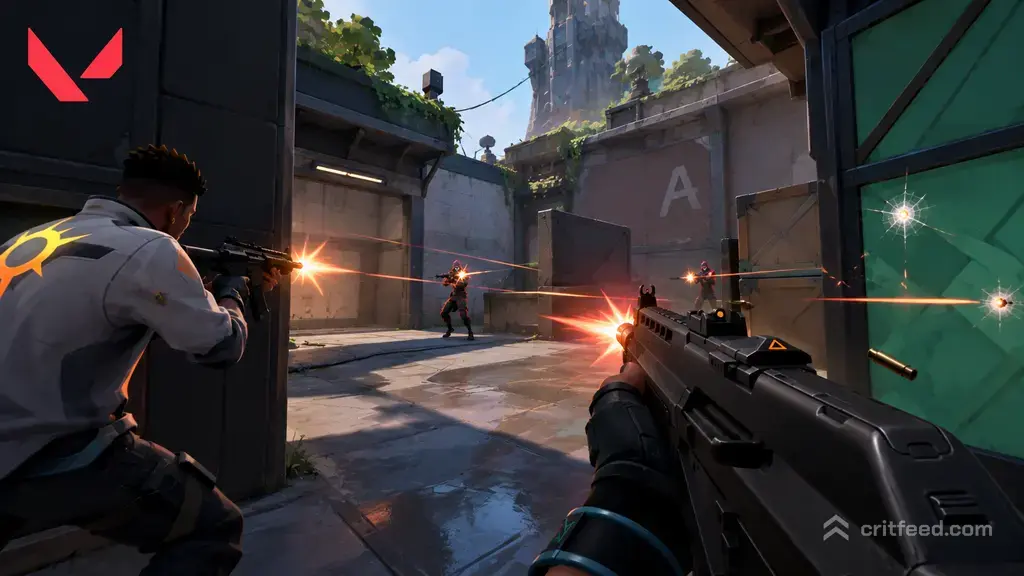
When a duel breaks out at close range, newer players often ADS by reflex. The scope animation locks you in place for a beat, you lose fire rate, and you die. Trust the hip fire crosshair. It is tuned to be lethal at the ranges most fights happen.
Spraying Without Counter-Strafing
Holding W or D while mashing left-click sends bullets everywhere except your target. The hip fire cone opens the second you move, and it stays open until you stop.
Using the Wrong Gun for the Range
A Judge is a hallway weapon. A Guardian is a long-sightline weapon. Picking the wrong tool is a bigger problem than any aim mistake. Our valorant beginners guide walks through weapon economy decisions in more depth.
Ignoring Agent Abilities That Affect Accuracy
Some abilities, like Jett’s Updraft or Raze’s Blast Pack, launch you into the air. Shooting while airborne is still inaccurate. The abilities are repositioning tools, not firing platforms.
Hip Fire in Different Scenarios
Site Entries
When you push onto a bomb site, you are moving fast and expecting contact at close range. Keep your crosshair at head height, hold angles with a wide pre-aim, and counter-strafe the moment you see red. Never scope while swinging a corner.
Holding Angles on Defense
Pre-aim the pixel where a head will appear. If you are holding a tight angle, you do not need to ADS. The enemy is walking into your crosshair.
Long Sightlines
This is the exception. On maps with long corridors, like certain angles on valorant icebox map, ADS with a Guardian or Marshal becomes correct. The range makes the first-shot accuracy bonus and the zoom worth the movement penalty.
Clutch Situations
In a 1v1 at close range with a Vandal or Phantom, hip fire wins. In a 1v1 across a long diagonal, scoping with a rifle can be worth it for the tighter first shot. Read the fight, do not default to one habit.
Training Hip Fire Accuracy
The Range is where you build this. Set bots to moving, set difficulty to hard, and practice two drills:
- Static tap fire: Stand still, place crosshair at head height, click one bot at a time. Build the reflex of trusting the first bullet.
- Strafe-tap-strafe: Walk left, counter-strafe, fire one shot, walk right, counter-strafe, fire. This mirrors a real peek.
Twenty minutes before a ranked session is enough to warm the muscle memory. If your aim feels off on a given day, check whether your network is clean too. Our write-up on valorant network rtt spikes covers how latency can make your shots feel inaccurate even when your mechanics are fine.
The Bottom Line
Valorant hip fire is not a backup plan, it is the primary firing mode for every rifle, SMG, pistol, and shotgun in the game. The scope exists for a handful of specific weapons and a handful of specific sightlines. Everywhere else, the open crosshair, the full movement speed, and the faster fire rate are what win the round.
Spend one practice session this week focused only on counter-strafing before every shot. That single habit will do more for your gunfights than any sensitivity tweak or crosshair change.