
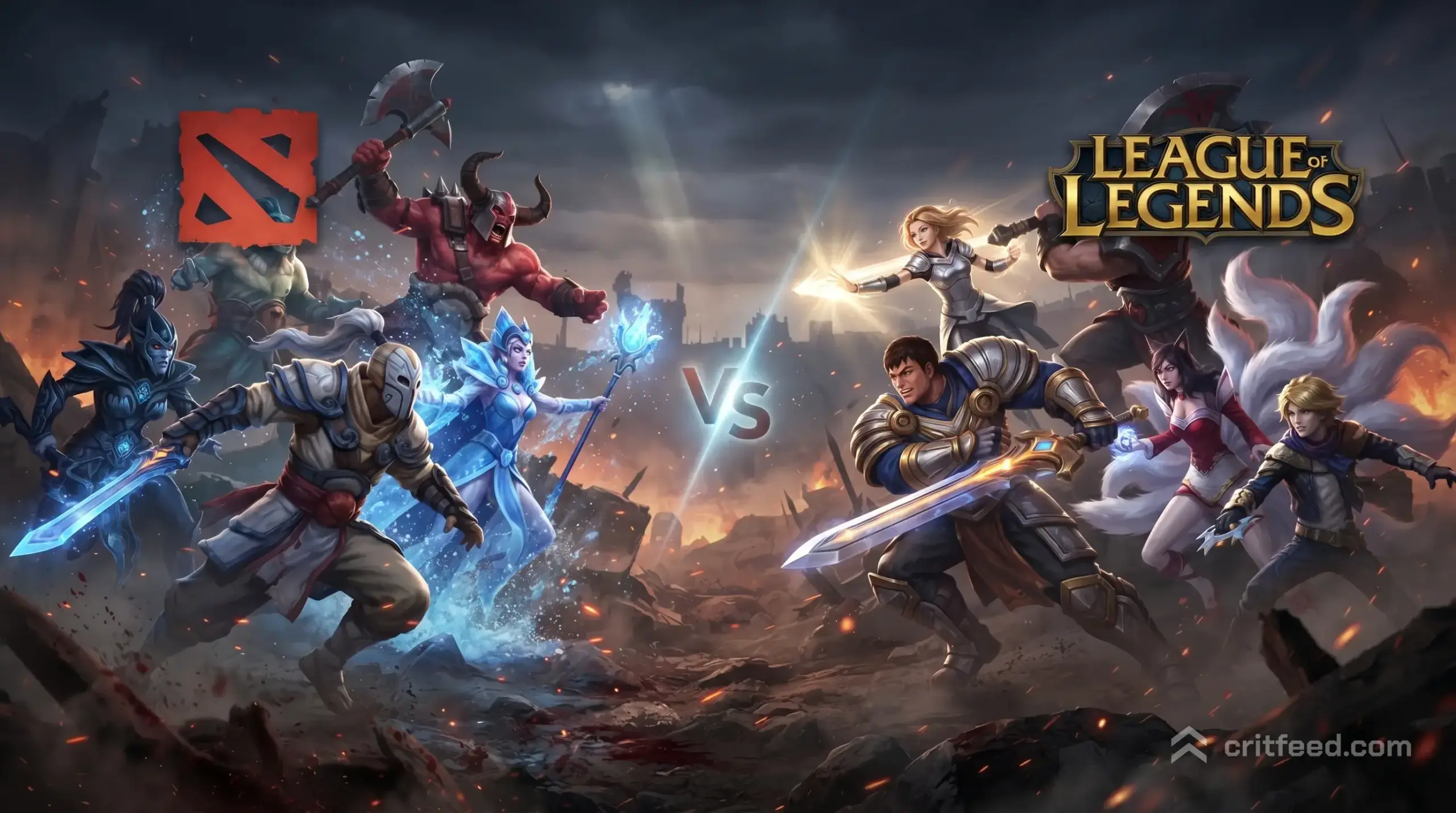
The Dota 2 vs League of Legends debate has run hot for over a decade, and most comparisons still miss the point. We are a Dota 2 publication, so we will not pretend both games are the same MOBA with different art — they are not. Below, we break down what actually separates them in 2026, from draft depth and item systems to the map, the economy, and the pro scene.
The Short Answer
Dota 2 is the deeper, harder, more punishing game. League of Legends is faster, cleaner, and easier to pick up.
That is not a slight on either side. It is the design philosophy. Valve’s Dota 2 keeps almost every mechanic Icefrog built into the original DotA mod and adds more on top. Riot’s League of Legends stripped the formula down to make it more accessible and pushes patches that shake the meta every few weeks.
If you want the full picture, keep reading.
Core Design Philosophy
Dota 2 rewards knowledge, patience, and map awareness. League of Legends rewards mechanics, reaction speed, and lane pressure.
Neither game is “casual.” But League’s average match runs 25–35 minutes, while Dota 2 games regularly stretch past 40. Dota also throws mechanics at you that League simply does not have:
- Denying your own creeps and towers to starve the enemy of gold and experience
- Courier deliveries (each player has their own now)
- Turn rates on heroes, so you cannot instantly face the other direction
- High ground vision advantage that can decide entire games
- Runes in the river that spawn on set timers
That last one matters. If you do not know when the Bounty Rune or Wisdom Rune spawns, you are losing free gold and XP every few minutes.
Heroes vs Champions
Both games have massive rosters, but the design gap is real.
| Feature | Dota 2 | League of Legends |
|---|---|---|
| Total playable characters | 126+ heroes | 160+ champions |
| Free to play | Every hero, always | Rotating free week + unlocks |
| Ability count per hero | 4 base + innate + facets | 4 abilities + passive |
| Ultimate re-work items | Aghanim’s Scepter & Shard | None equivalent |
The biggest difference: Dota 2 gives you every hero for free from day one. In League, you unlock champions with Blue Essence or Riot Points. That single choice changes how new players approach each game.
Dota heroes also feel more mechanically dense. Invoker has 10 spells. Meepo controls up to five clones. Rubick can steal any enemy ultimate mid-fight. If that sounds overwhelming, our dota 2 best heroes for beginners list walks through simpler picks like Wraith King, Lion, and Sniper.
Items and the Economy
This is where the games truly split.
Dota 2’s item system is closer to a puzzle. Aghanim’s Scepter rewrites a hero’s ultimate. Aghanim’s Shard adds a whole new ability. Neutral items drop from jungle camps at set timers. Boots of Travel let you global-teleport to any friendly building. Black King Bar grants magic immunity — a mechanic League does not have at all.
League’s items are more streamlined. You build toward Mythic and Legendary items, and the shop guides you with recommended builds. There is no active-item skill ceiling on the same scale as Dota’s BKB, Blink Dagger, or Force Staff.
Key economic differences:
- Dota heroes lose gold on death (League does not punish you the same way)
- Dota lets you deny last-hits on your own creeps
- Dota’s neutral creeps drop tiered items on a timer
- League has a shared jungle economy tied to the jungler role
The Map and Lane Roles
Both maps are three-lane with a jungle, but they play differently.
Dota 2 uses the Radiant vs Dire split — a bottom-left green side and a top-right red side — with an asymmetrical layout that favors different sides at different stages of the game. League’s Summoner’s Rift is more symmetrical.
Dota positions are numbered 1 through 5:
- Position 1 — Hard carry, safelane
- Position 2 — Mid
- Position 3 — Offlaner
- Position 4 — Soft support / roamer
- Position 5 — Hard support
League uses named roles: top, jungle, mid, ADC, and support. Functionally similar, but Dota’s offlane is closer to a solo bruiser role, and hard support is a full-time babysitter with real playmaking tools. If support is your calling, our dota 2 support guide breaks down how to actually influence the game from position 5.
Roshan is Dota’s Baron equivalent, but with a twist. He drops the Aegis of the Immortal — a second life for whoever picks it up — plus a Cheese and Refresher Shard at later kills. That single item can flip entire teamfights.
Learning Curve
We will not sugarcoat it. Dota 2 is harder to learn.
The 2024 Reddit thread from a player who switched from League to Dota after 3 years captures it well — they described feeling lost for weeks, then addicted. That is a common story. The mechanics that make Dota deep also make it intimidating:
- Denies
- Turn rates
- Item actives on almost every core item
- Vision and warding depth
- Camp stacking and pulling
League smooths most of that out. That is why its player base is significantly larger — Riot has consistently reported over 100 million monthly active users, while Dota 2 peaks around 700,000 concurrent players on Steam.
If you want to shortcut the learning curve, dial in your dota 2 best settings first, then work on dota 2 warding spots — vision alone will boost your winrate more than any hero pick.
Esports and the Pro Scene
Both games have world-class competitive scenes, but they run on opposite models.
Dota 2’s The International (TI) has historically featured the largest prize pools in esports history, peaking at over $40 million in 2021 thanks to crowdfunded Battle Pass sales. Valve has since scaled TI prize pools back down closer to Valve-funded baselines, but the tournament remains the sport’s pinnacle.
League of Legends Worlds runs on a franchised regional model — LCS, LEC, LCK, LPL — with a smaller but more consistent prize structure and larger viewership numbers. The 2023 Worlds final broke concurrent viewership records above 6 million peak.
The gap in approach:
- Dota: Fewer, higher-stakes events with the DPC and TI as the anchors
- League: Year-round regional leagues feeding into Worlds and MSI
For the Dota side, Icefrog’s design philosophy still shapes every patch that hits the pro scene.
Patches and Meta Shifts
Valve ships big Dota 2 patches every few months, and they change the game hard — new items, reworked heroes, sometimes entire map changes. Patch 7.41e brought its own set of headaches; see our writeup on dota 2 patch 7.41e bugs for the specifics.
League patches every two weeks. Smaller shifts, more of them. Riot tunes numbers constantly; Valve rewrites systems.
Which is better? Depends on your taste. League’s cadence keeps things fresh. Dota’s slower, larger patches let a meta actually develop before it gets nuked.
Toxicity and Community
Both communities have a reputation. Neither is great.
Dota 2 has systemic responses: the dota 2 conduct summary tracks your behavior score, and low scores get shuffled into low-priority queues with other flamers. Report abuse is punished with mute stacks.
League has honor systems and chat restrictions but leans harder on champion mastery and clash tokens to reward positive play.
Anecdotally, Dota’s older, smaller community is more veteran-heavy and less patient with new players. League’s larger base means more variance — you will meet worse and better teammates on the same day.
Which One Should You Play?
Play Dota 2 if:
- You like deep strategy over pure mechanics
- You want every hero unlocked from day one
- You enjoy long, high-stakes matches
- Item actives and drafting nerds sound fun
Play League of Legends if:
- You want faster games
- You prefer flashy mechanical outplays
- You like a smoother onboarding
- You enjoy champion-collection progression
The good news: both games are free. Try each for a week. You will know within ten matches which one grabs you.
The Bottom Line
Dota 2 and League of Legends are cousins, not clones. Dota is the strategic heavyweight with denies, actives, and 40-minute chess matches. League is the sharper, faster, more accessible MOBA with a bigger player base and tighter game times.
Neither is “better” — they optimize for different players. If you land on Dota, our dota 2 ranks guide is the next stop for understanding the MMR ladder and where you actually fit.