
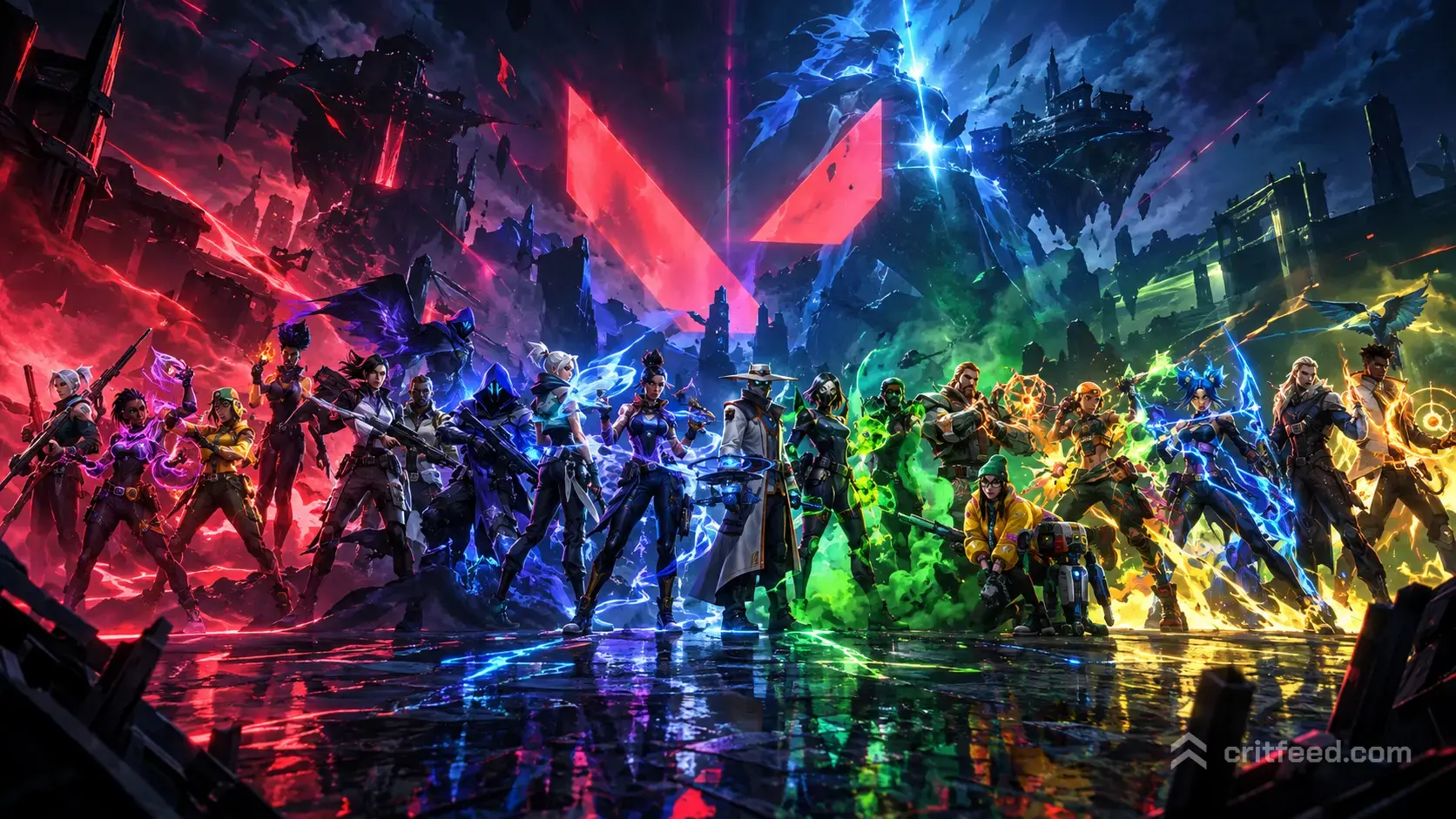
Picking the right Valorant characters is the difference between carrying your team and hard-throwing eco rounds. Valorant’s roster is split into four distinct roles, and each agent has a kit built to solve a specific problem on the map. We’ll break down how the role system works, what each role actually does, and how to pick an agent that fits your playstyle.
If you’re brand new to the game, our valorant beginners guide covers the fundamentals before you commit to a main.
How Valorant Characters Are Classified
Every agent in Valorant belongs to one of four roles. These roles decide the tools you bring to a round: information, space, safety, or shutdown power.
- Duelists create space and get first kills
- Initiators gather info and clear angles for the team
- Controllers block sightlines with smokes and vision denial
- Sentinels lock down flanks and hold sites
A standard team composition uses one of each role, plus a flex pick based on the map. Playing outside your role without communication is one of the fastest ways to lose rounds, which our valorant tips and tricks breakdown explains in more detail.
Duelists: The Entry Fraggers
Duelists are your self-sufficient aggressors. Their kits are built around getting into sites first, taking duels, and forcing the enemy team to react. If you love aim duels and want the freedom to make plays, this is your role.
Core Duelist Agents
- Jett: Korean windwalker with a dash, updraft, smoke cloud, and knives ultimate. Rewards precise Operator play.
- Raze: Brazilian explosives expert. Boom Bot, Blast Packs, Paint Shells, and the Showstopper rocket launcher.
- Reyna: Self-healing lifesteal duelist. Devour and Dismiss trigger on kills, making her a solo-carry pick.
- Phoenix: Fire-based duelist with self-healing molotovs and walls, plus a “get out of jail free” Run It Back ultimate.
- Yoru: Deception duelist with fake footsteps, a teleport, a flash, and a Dimensional Drift stealth ultimate.
- Neon: Filipino sprinter who slides, stuns with electric walls, and hip-fires a lightning beam ultimate.
- Iso: Damage-immunity duelist who builds a shield off kills and traps enemies in a 1v1 arena.
- Waylay: Light-based duelist built around fast repositioning and multi-target displacement.
Key takeaway: Duelists take space, but they don’t win rounds alone. Your team has to trade you.
Initiators: The Information Machines
Initiators soften up sites before your duelist ever peeks. Their abilities scan, blind, or displace enemies so the rest of the team can push safely.
Core Initiator Agents
| Agent | Signature Tool | Best For |
|---|---|---|
| Sova | Recon Bolt, Owl Drone | Info on any map |
| Skye | Trailblazer, Guiding Light | Team fights |
| KAY/O | Suppression knife, flashes | Anti-utility executes |
| Breach | Fault Line stun, flashes | Tight corridors |
| Fade | Prowler nightmare seekers | Tracking enemies |
| Gekko | Wingman plant/defuse creature | Retake flexibility |
| Tejo | Guided missile, cluster utility | Long-range site clears |
Sova’s Recon Bolt is still the gold standard for map-wide information, while Breach dominates on maps with narrow chokepoints. Gekko is unique because his creatures can plant or defuse the Spike for you.
Controllers: The Map Painters
Controllers own the smokes. They shape the map, block off angles, and dictate where fights happen. Every serious team needs a controller who can consistently execute smoke lineups.
Core Controller Agents
- Brimstone: American commander with map-based smokes, a Stim Beacon, an incendiary, and the Orbital Strike ultimate.
- Omen: Shadow controller with two-way teleport, a paranoia blind, and a global teleport ultimate. Our full breakdown of Valorant’s Omen kit covers his lineups in detail.
- Viper: Chemical controller who runs a Toxic Screen wall and Poison Cloud orb. Best on long, open maps.
- Astra: Ghanaian astral projector who places stars anywhere on the map to convert into smokes, stuns, or pulls.
- Harbor: Indian controller with water walls that block bullets, plus a Cascade wave and a Reckoning ultimate.
- Clove: Non-binary Scottish immortal who can smoke and reactivate abilities even after dying.
Key takeaway: If nobody on your team locks a controller, you have no smokes, and you will lose.
Sentinels: The Site Anchors
Sentinels hold down bomb sites and cover flanks. Their kits are defensive by design: traps, walls, trip wires, and abilities that punish over-aggressive pushes.
Core Sentinel Agents
- Cypher: Moroccan spy with trip wires, a Spycam, and Neural Theft. King of information denial.
- Killjoy: German engineer with a turret, alarm bot, nanoswarm grenades, and a Lockdown ultimate that detains everyone in range.
- Sage: Chinese healer with a slow orb, a barrier wall, healing, and the only resurrection ultimate in the game.
- Chamber: French weapons designer with a teleport anchor, a trap, and Tour De Force sniper ultimate.
- Deadlock: Norwegian sentinel with sound sensors, a barrier mesh, and a nanowire ultimate that captures enemies.
- Vyse: Metallic sentinel who traps weapons and stalls executes with melting metal walls.
Sage is still the only agent who can bring a teammate back to life, which makes her invaluable on retakes and clutch rounds.
Which Valorant Characters Should You Play?
Your pick should match three things: your aim, your comms, and the map. Here’s a quick decision framework.
If You Have Sharp Aim and Fast Reactions
Play Jett, Reyna, Chamber, or Iso. These agents reward mechanical skill and let you take fights on your terms.
If You Like Setting Up Teammates
Play Sova, Skye, Omen, or Brimstone. Information and utility are your currency.
If You Prefer Holding Angles and Playing Smart
Play Cypher, Killjoy, Sage, or Deadlock. Anchor a site, punish pushes, and clutch retakes.
If You Want Maximum Flex Value
Play Gekko, Clove, or KAY/O. Their kits work on almost every map without much roster juggling.
Map-specific picks matter too. Viper is a top-tier pick on longer maps like Icebox and Breeze, and our Icebox map guide covers her wall placements.
Unlocking Valorant Characters
Not every agent is available from day one. New accounts start with a small default roster, and the rest are unlocked through XP-based agent contracts or bought directly with Valorant Points.
Each agent contract has 10 tiers, and completing the contract unlocks the agent for free. If you’re grinding contracts, our guide on free Valorant Points methods covers legitimate ways to speed things up.
Newly released agents are typically gated behind a short-term unlock quest during their release act, then move onto the standard contract system afterward. Check our Valorant new act notes for the current unlock structure.
The Bottom Line
Valorant’s roster is built around four roles, and knowing what each role does is more valuable than memorizing every ability. Pick a role first, then a main inside that role, then a second flex pick. That is how climbing ranks starts.
The meta shifts with every balance patch, so exact tier placements move around. What doesn’t move is the underlying logic: duelists take space, initiators clear it, controllers hide it, and sentinels defend it.
Ready to lock in your main? Start with one agent per role, learn their utility lineups on two or three maps, and build from there. Our full Valorant matchmaking breakdown explains how role-swapping affects your rank climb.