
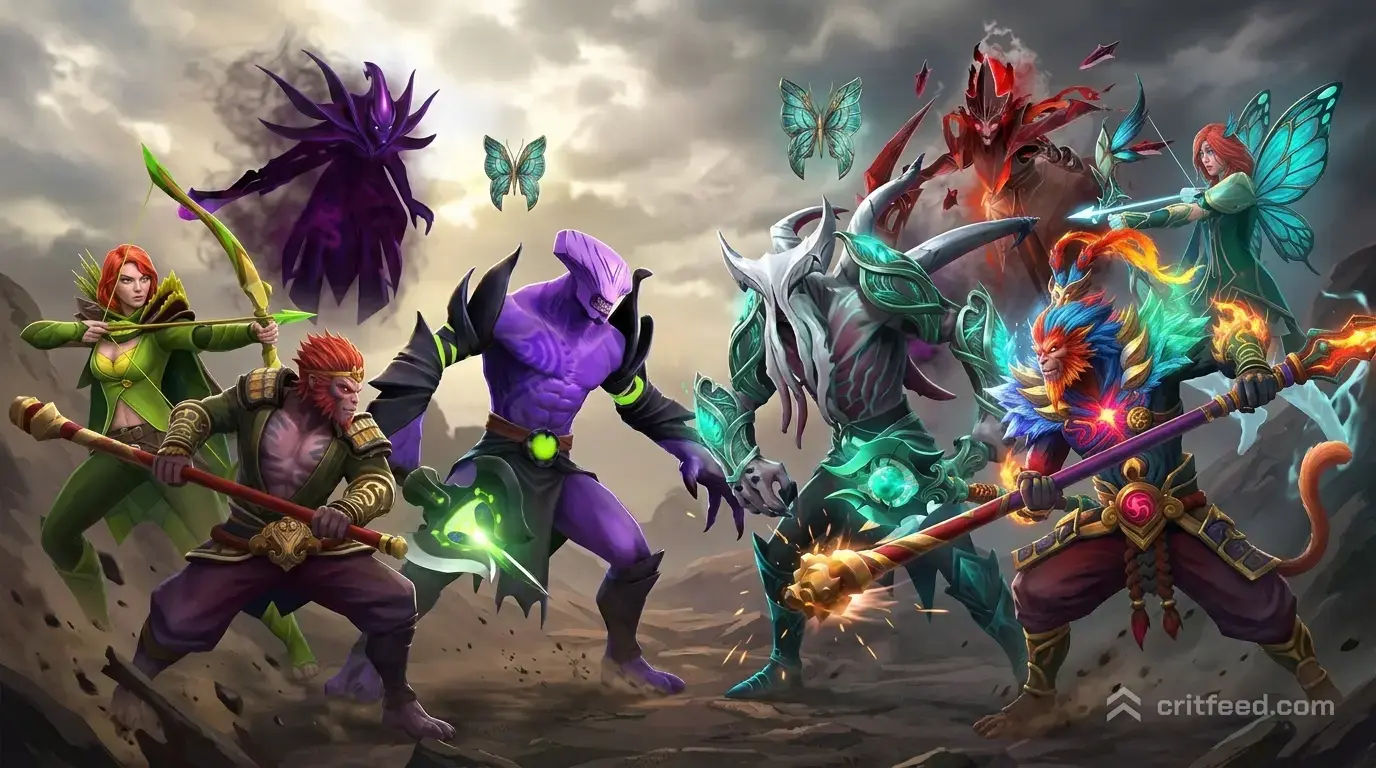
Dota 2 Skins Explained: Rarities, Trading & Value
Dota 2 skins are cosmetic items that change how your hero, courier, ward or map looks without touching gameplay. We will walk through where they come from, how rarities work, and how trading actually plays out on the Steam Community Market and third-party sites. By the end you will know what you are looking at when a Mythical drops at the end of a game.
What Dota 2 Skins Actually Are
In Valve’s own language, these are cosmetic items: in-game drops, chest openings or purchased pieces that re-skin a hero, a courier, a ward, the HUD or the terrain.
They do not change ability values, cooldowns or damage. A hero wearing a Collector’s Cache set hits exactly as hard as one in default gear. The whole system is visual, with one caveat we cover below.
Cosmetics are tied to your Steam account and most of them can be marketed, traded or stored in the Armory. A smaller slice is locked to your account forever.
The Slot System: How Sets Are Built
Every hero has a set of equipment slots. Most heroes carry between six and ten slots, covering things like head, shoulders, weapon, back, arms, legs and belt.
A full “set” is a themed collection of items that fills every slot on one hero. Loading screens, taunts and emoticons sit outside those slots as separate categories.
Beyond hero equipment, the main cosmetic categories are:
- Couriers, including rare unusual couriers with particle effects
- Wards, which change the look of Observer and Sentry Wards
- HUD skins, which re-skin the in-game interface
- Terrain and map skins, which replace the look of Radiant or Dire territory
- Weather effects, like snow or rain across the map
- Announcer packs and mega-kill announcers, which are audio cosmetics
- Loading screens, emoticons, sprays and chat wheels
For a deeper look at what a full terrain reskin actually changes, our dota 2 map skin breakdown walks through it.
Rarity Tiers You Will See
Every cosmetic in Dota 2 carries a rarity colour. The scale, from most common to rarest, works like this:
| Rarity | Typical Source |
|---|---|
| Common | Basic chest drops, starter items |
| Uncommon | Chests and early-game drops |
| Rare | Chests, event rewards |
| Mythical | Collector’s Cache sets, high-tier chests |
| Legendary | Rare chest drops, select sets |
| Immortal | Battle Pass and event Immortal Treasures |
| Arcana | Dedicated Arcana releases, one hero at a time |
| Ancient | Limited unusual couriers and rare drops |
Arcanas are the big one. An Arcana is a full remodel of a hero’s look, voice lines, particles, animations and often the kill effects. These are released individually and priced accordingly.
Immortals sit just below. They typically add particle effects and animation tweaks to a single slot rather than a whole-hero rework.
Where Dota 2 Skins Come From
There is no single store wall in Dota 2. Cosmetics enter the economy through several channels, and the channel matters because it decides whether an item is tradeable.
End-of-Match Drops
After some matches you receive a free item. These are usually Common or Uncommon, and often start as untradeable for a cooldown period.
Treasures and Collector’s Caches
A Treasure is Valve’s version of a loot chest. You open it and receive one item from the published pool, with the rarer items having lower drop odds.
Collector’s Caches are community-made sets voted on through the Steam Workshop. They are released in waves and are usually locked to the account for a window before becoming tradeable.
The Dota 2 Store
Valve’s in-client store sells bundles, individual sets, Arcanas and Personas directly. Items bought here are typically tradeable after the standard Steam cooldown.
Battle Pass and Events
When Valve runs a seasonal event, event-exclusive Immortals, taunts and terrain often come with it. Some of these become permanently untradeable once the event ends, which is why old Battle Pass items can be worth real money years later.
The Steam Community Market
The second-hand market where players sell items to each other for Steam Wallet funds. Valve takes a cut on every sale.
Third-Party Marketplaces
Sites like DMarket, CS.MONEY and others let players trade Dota 2 skins for cash out, which the Steam Market does not allow. We cover the trade-offs below.
Trade Locks, Gift Locks and the Armory
Three mechanics decide whether you can move an item:
- Trade lock: a cooldown, usually around a week after an item moves accounts, during which it cannot be traded or sold again.
- Gift lock: event or purchased items sometimes carry a longer lock, often 30 days.
- Account-bound items: event drops, achievement rewards and some tournament items are never tradeable.
The Armory is the in-client inventory system where you equip, preview and manage your cosmetics. Items sitting in the Armory are still part of your Steam inventory and still tradeable, if they are tradeable at all.
Gems, Sockets and the One Gameplay Caveat
Some items have gem sockets. Gems are tiny attachments that track statistics or add effects:
- Prismatic Gems change the colour of effects on the item.
- Ethereal Gems add particle effects, like fire or lightning on a weapon.
- Kinetic Gems change the hero’s animations.
- Stat-tracking Gems count kills, assists or wards placed while equipped.
A socketed item is usually worth more than the same item without the gem, and specific gem and item combinations can push prices sharply higher.
The “gameplay caveat” we mentioned earlier: a Kinetic Gem can make a hero’s animation faster or more compact, which some players find easier to read. The hit still lands at the same point in game logic, but the visual read changes.
What Makes a Dota 2 Skin Valuable
Price is driven by five factors, roughly in this order:
- Scarcity. If the item came from an event that ended years ago and is now untradeable in future drops, supply is fixed.
- The hero. Cosmetics for popular heroes command higher prices because more players want them. Our dota 2 hero tier list tracks who is actually being picked.
- Rarity tier. Arcana and Immortal items hold value better than Common and Uncommon drops.
- Effects. Items with Unusual particles, strong Ethereal Gems or clean Prismatics sell for a premium.
- Age. Early Collector’s Cache sets and discontinued Battle Pass items appreciate over time.
The clearest rule: untradeable turning tradeable, or tradeable turning untradeable, is the single biggest price mover in Dota 2 cosmetics.
Steam Market vs Third-Party Marketplaces
Both routes are legitimate. They solve different problems.
| Factor | Steam Community Market | Third-Party Marketplaces |
|---|---|---|
| Payout | Steam Wallet only | Real-money cash out |
| Fees | Valve’s cut on each sale | Platform fee, varies by site |
| Account risk | Lowest | Higher, requires API trust |
| Price ceiling | Capped per item | Uncapped |
| Rare item availability | Full | Full, often cheaper for high-tier items |
If you only want to buy items to use in-game, the Steam Market is the simpler path. If you want to turn a rare set into actual money, third-party sites are the only option.
Common Mistakes New Collectors Make
We see the same ones often enough to list them:
- Opening Treasures hoping for a specific item. The drop pool is published. If you want a specific set, buying it on the market is almost always cheaper than opening chests.
- Buying during event hype. Prices spike during a new release and fall once the item unlocks for trade. Waiting weeks saves real money.
- Ignoring the trade lock. New purchases sit under a Steam cooldown. Factor that in before buying something to flip.
- Forgetting the hero. A Mythical for a hero nobody plays will sit in your inventory. Buy skins for heroes you actually use, especially if you are still working out which dota 2 best heroes for beginners suit you.
- Skipping gem history. A kill-tracker gem with a huge number on it adds real value. Check before you sell.
How to Preview Before You Buy
Dota 2 lets you load a hero model and try on cosmetics inside the client. Head to the Armory, pick the hero, and use the Preview function on any item before committing.
Many third-party marketplaces also offer in-browser 3D previews, which is useful when comparing styles or checking for a specific gem effect.
If you are new to the game, we would steer you toward getting a feel for dota 2 best settings and the fundamentals of a dota 2 laning guide long before you drop money on cosmetics. The cosmetic market is not going anywhere.
The Bottom Line
Dota 2 skins are a mature cosmetic economy built on four pillars: slot-based hero sets, rarity tiers, Treasure and event drops, and a two-track market split between Steam and third-party sites. The gameplay never changes, but your visuals, animations and audio can be rebuilt from top to bottom.
The one piece of advice that holds across every patch and every event: buy for heroes you actually play, and wait out the trade lock windows. That alone will save you more money than any price guide.