
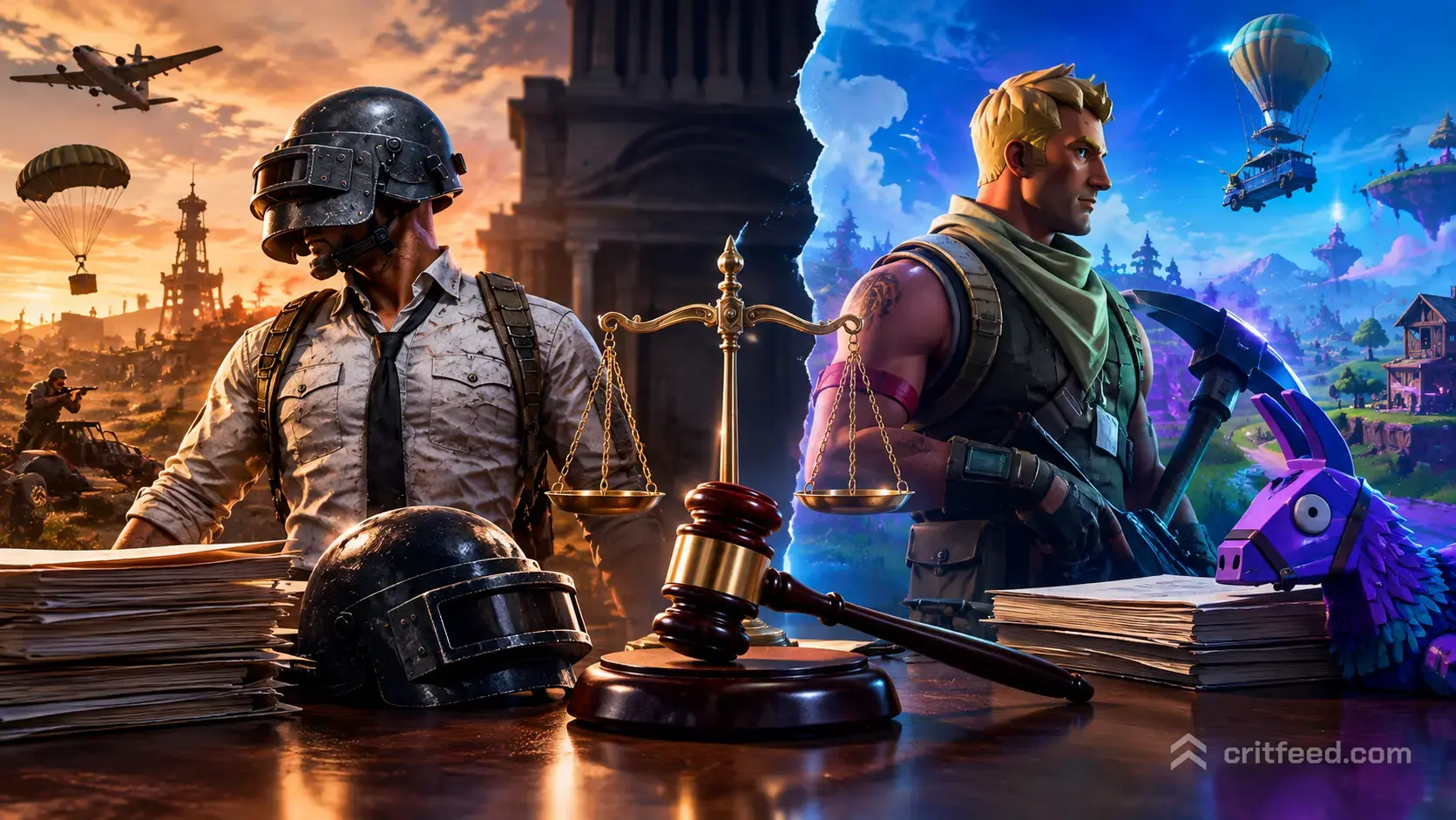
The PUBG Fortnite lawsuit has been over since June 2018, when PUBG Corp quietly dropped its copyright case against Epic Games with no public explanation. If you landed here hoping for a live courtroom drama, there isn’t one. What’s left is a strange slice of battle royale history that still shapes how we think about genre, cloning and the Unreal Engine business.
Here’s the actual record of what happened, who filed what, and why the whole thing fizzled out.
What the Lawsuit Was Actually About
In January 2018, Bluehole’s subsidiary PUBG Corp filed a copyright infringement suit against Epic Games in a South Korean court. The claim: that Fortnite Battle Royale copied elements of PlayerUnknown’s Battlegrounds, from the shrinking play zone to the general look of its UI and items.
This wasn’t out of nowhere. Back in September 2017, Bluehole VP Chang Han Kim had already said publicly that the studio was “contemplating further action” after Epic launched Fortnite’s battle royale mode. His complaint focused on two things:
- Fortnite’s battle royale mode launched after PUBG’s success, built by the same company that licensed PUBG the Unreal Engine
- Epic Games had been publicly promoting PUBG on its own channels before pivoting to a competing mode
The awkward twist: PUBG itself runs on Unreal Engine 4. Epic Games is both PUBG’s engine vendor and, with Fortnite, its biggest competitor. That business relationship is a big reason this case was always going to be complicated.
The Timeline
| Date | Event |
|---|---|
| September 2017 | Fortnite Battle Royale launches, free to play |
| September 2017 | Bluehole publicly criticises Epic, hints at legal action |
| January 2018 | PUBG Corp files copyright suit in South Korea |
| June 2018 | PUBG Corp withdraws the lawsuit without explanation |
That’s the whole arc. Roughly five months from filing to dropping it, with no settlement figure, no public statement from PUBG Corp, and no court ruling on the merits.
Why PUBG Dropped the Case
Neither company said anything on the record when the suit was withdrawn in June 2018. The Guardian’s Keith Stuart reported the news as a straight withdrawal “without explanation,” and that remains the official position: no reason given.
The widely-held read, though, points at a few obvious pressures.
The engine problem. PUBG was built on Unreal Engine 4, which Epic Games owns. A protracted legal fight with your own engine provider is a bad long-term bet, especially when you’re still shipping updates on that engine.
The genre problem. Battle royale as a concept predates PUBG. The shrinking-circle, last-player-standing format was popularised by the ARMA 2 mod DayZ: Battle Royale and the H1Z1 variants, both of which PlayerUnknown himself (Brendan Greene) worked on before PUBG. Suing over “a battle royale shooter exists” was never going to be a clean win.
The timing problem. By mid-2018, Fortnite had exploded into a cultural phenomenon with hundreds of millions of players. The lawsuit’s practical value had already evaporated.
What This Means for PUBG Today
The lawsuit is a closed chapter, but it still shows up in two places that matter to current players.
The “Clone Wars” Framing Never Really Ended
Players still argue about which game copied what. If you want a fair side-by-side of how the two titles actually play now, our breakdown of pubg vs fortnite covers the gunplay, movement and tempo differences without the legal baggage.
Krafton Is a Very Different Company Now
Bluehole restructured and PUBG Corp eventually became part of Krafton, which is now the publisher of record. If you’re new to the ecosystem and wondering who owns and runs the game today, our pubg owner explainer walks through the corporate structure. For a refresher on the name itself, what does pubg stand for covers the full title.
The Broader Legal Precedent (Or Lack of One)
Because PUBG Corp withdrew the case before any ruling, no legal precedent was set. The battle royale genre remains legally open territory. Any studio can build one, and the only real constraints are:
- Not copying specific protectable assets (art, code, UI elements verbatim)
- Not infringing on trademarks (names, logos)
- Not breaching engine or asset licenses
Game mechanics themselves, including the shrinking zone, loot drops and 100-player lobbies, are not copyrightable in the US or South Korea. The lawsuit never got far enough to challenge that.
What Happened to the Companies After
Both studios came out of 2018 in very different shapes.
Epic Games went on to turn Fortnite into one of the biggest entertainment properties on the planet, then picked a much bigger legal fight with Apple over App Store fees in 2020. The Fortnite-PUBG spat looks tiny next to that.
PUBG Corp (now Krafton) focused on stabilising the PC game, expanding into mobile with Tencent, and launching the PUBG Global Championship (PGC) as its flagship esport. The game is still actively supported today, and if you’re wondering whether the player base held up, our is pubg dead piece looks at the current state of the servers and the competitive scene.
The Bottom Line
Where things stand right now in 2026:
- The lawsuit is permanently closed. PUBG Corp dropped it in June 2018 and has not refiled.
- No settlement terms were ever disclosed. Any claim you see online about a specific payout is unsourced.
- Both games still run on Unreal Engine. The business relationship between Krafton and Epic survived.
Open questions that genuinely have no public answer:
- Whether any private settlement, licensing adjustment or engine deal was part of the withdrawal
- Whether internal pressure from Tencent, which had stakes in both companies at various points, influenced the decision
If any of that ever gets confirmed on the record, we’ll update this page.
What to Focus On Instead
The lawsuit is a footnote. The game it was fought over is still here and still worth your time if you like methodical, gear-heavy shooters. If you’re coming back to PUBG after a long break or starting fresh, the fastest wins are usually in your settings and your drop choices, not your aim: our best pubg settings rundown and the pubg beginner guide will get you further in a weekend than any amount of courtroom trivia.
The real story of PUBG in 2026 is on the servers, not in the filings.