
Ever finished a match with 30 kills and gained only 12 RR then lost the next one and dropped 20? You’re not imagining it. How does Valorant matchmaking work is one of the most misunderstood systems in the game, because Riot uses two hidden numbers to sort you, not just the shiny rank on your card.
In this guide, we’ll break down exactly how the system picks your teammates, how your rank moves after each match, and what you can do to climb faster.
The Two Numbers That Control Everything
Valorant’s Competitive queue runs on two separate ratings working side by side:
- MMR (Matchmaking Rating) — a hidden skill score the system uses to build fair games
- RR (Rank Rating) — the visible points you earn or lose each match, which decides your rank tier
Your MMR is the “real” measure of your skill. Your rank is just the system’s best public guess at where your MMR sits. When those two disagree, the game tries to correct itself — fast.
Key takeaway: You are matched by MMR, not by rank. That’s why a Gold player on a hot streak can suddenly see Platinum lobbies before their icon changes.
The Rank Tiers
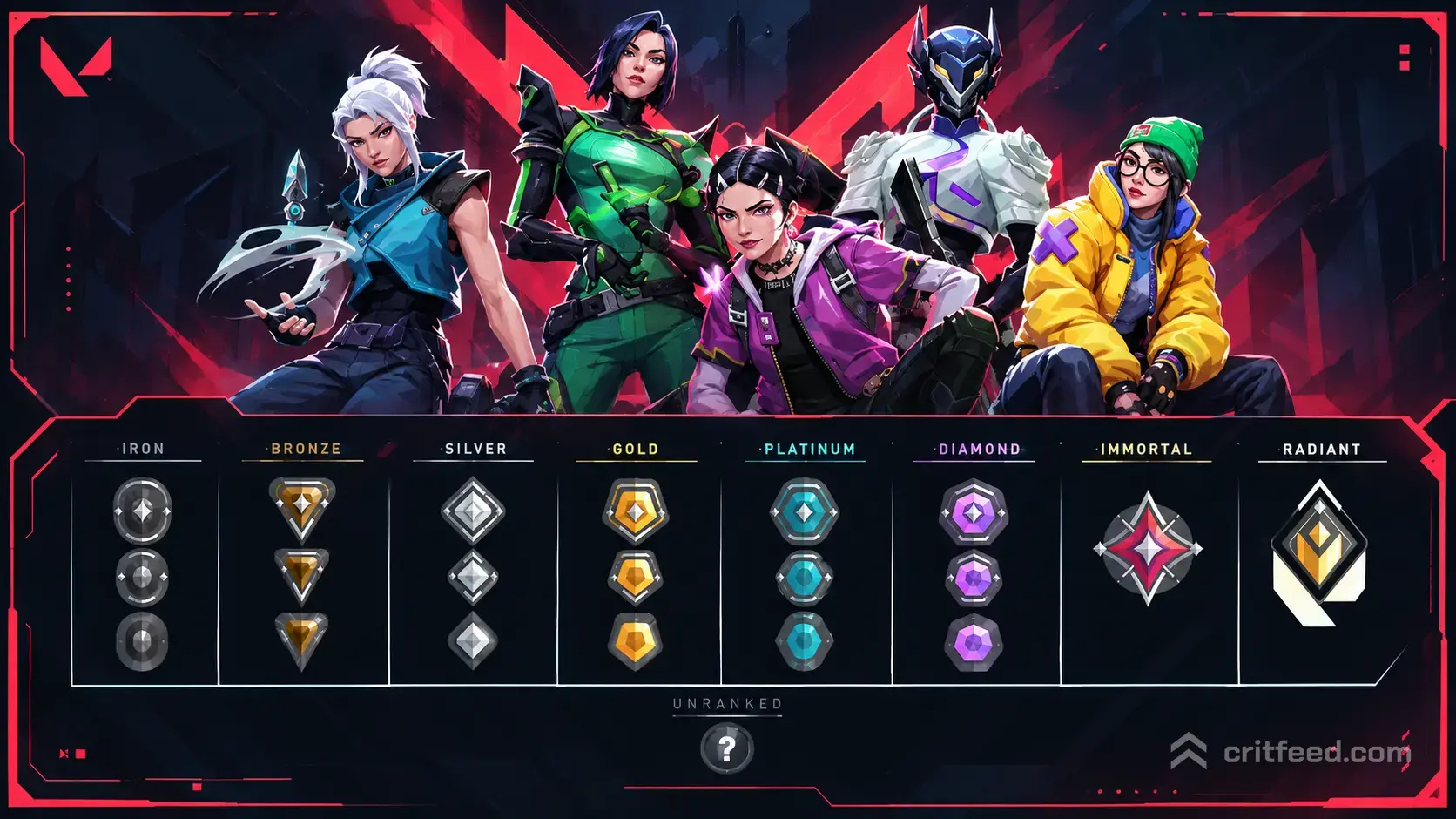
Valorant has nine ranks, each split into three tiers, except for the top rank.
| Rank | Tiers |
|---|---|
| Iron | 1, 2, 3 |
| Bronze | 1, 2, 3 |
| Silver | 1, 2, 3 |
| Gold | 1, 2, 3 |
| Platinum | 1, 2, 3 |
| Diamond | 1, 2, 3 |
| Ascendant | 1, 2, 3 |
| Immortal | 1, 2, 3 |
| Radiant | Top 500 per region |
Radiant is different. It’s a capped rank reserved for the top 500 players in each region. Once you cross the Immortal 3 RR threshold, you compete on a leaderboard where standing not tier is what matters.
Placement Matches: How the System Sizes You Up
Before you get a rank, you play five placement matches. Your performance, wins, and hidden MMR from those games decide your starting tier.
If you played Competitive in a previous act, the system already has a strong read on you. Your new placement will land close to where you left off, usually a couple of tiers lower to make you re-earn the top of your range.
New accounts must first reach Account Level 20 by playing Unrated and other modes before Competitive unlocks. This is Riot’s way of making sure you at least know how a plant, defuse, or ability economy works before you get sorted.
If you’re brand new, our Valorant beginners guide walks you through the fundamentals you’ll need before your placements.
How RR Is Calculated After Every Match
After each Competitive game, three things decide how much RR you gain or lose:
- Win or loss — the biggest single factor by far
- Round difference — a 13-3 stomp moves RR more than a 13-11 grind
- MMR vs. rank gap — if your MMR is higher than your rank, you gain more and lose less; if it’s lower, the opposite
Individual performance (kills, assists, ADR) has a smaller effect, and it shrinks as you climb. In Iron through Gold, a great scoreline can noticeably pad your RR. In Immortal and above, only wins move the needle.
Typical RR Movement
| Situation | RR Change |
|---|---|
| Standard win | +15 to +30 |
| Standard loss | -15 to -25 |
| Win with MMR above rank | Up to +50 |
| Loss with MMR below rank | As low as -10 |
| Draw | -2 to +2 |
Numbers are approximate. Riot has adjusted the formulas across many acts, so the ranges shift over time. Check the Valorant patch notes for the latest tuning changes.
Promotions, Demotions, and the Safety Net
Reaching 100 RR in a tier and winning your next match promotes you. There is no traditional promotion series one win at 100 RR seals it.
Demotion is a little kinder. You need to drop below 0 RR in your current tier to fall down, and you get a small buffer on the first loss at 0. This is designed to stop a single bad night from tanking your entire climb.
The floors work in reverse for the top ranks: once you hit Immortal, you can drop back to Ascendant 3, but you’ll never fall below your act’s peak by more than one full rank.
Party Restrictions: Who You Can Queue With
To keep matches fair, Valorant limits how far apart your party’s ranks can be. The rules tighten as you climb.
| Your Rank | Allowed Rank Gap |
|---|---|
| Iron 1 – Ascendant 1 | Within 3 tiers |
| Ascendant 2 – Immortal 3 | Within 1 tier |
| Radiant | Immortal 3 and Radiant only |
Five-stacks get more freedom than solo/duo queues at lower ranks, but they pay for it: a five-stack with a wide skill gap will face stiffer opponents and receive reduced RR on wins.
Solo and duo queue players are matched into lobbies with a mix of party sizes, but the system tries to keep five-stacks facing other five-stacks when possible.
How Teams Are Built
Once the matchmaker has enough players in queue, it sorts them into two teams by MMR. Its goals, in order:
- Balance total team MMR so the match is close to a coin flip
- Match party sizes (five-stack vs. five-stack ideally)
- Keep individual skill gaps small so no one player dominates
Longer queue times usually mean the system is loosening these rules to find you a game at all. That’s when you get the “wide skill gap” lobbies where the scoreboard looks lopsided from round one.
Act Rank and Peak Rank
Each Act, the game tracks your Act Rank a badge that shows your highest wins during that Act. It’s based on your top nine wins, so grinding matters even after you plateau.
At the end of each Act, you also get an Act Rank Triangle displaying your peak. This resets with the Valorant new act, giving everyone a fresh badge to chase.
Your MMR is soft-reset between Episodes, not Acts. That’s why your first ranked games after an Episode change usually feel harder the system is re-verifying your skill and RR gains often look smaller until it settles.
Premier vs. Competitive Matchmaking
Premier is Valorant’s team-based mode that uses a separate rating system from Competitive. Your team’s Premier Score determines your division, and you play scheduled weekly matches on a fixed map pool.
The two systems don’t affect each other. Grinding Premier won’t move your Competitive RR, and vice versa. Premier is designed for players who want a team experience closer to what pros play in VCT, while Competitive stays the standard solo/duo climb.
What You Can Actually Do to Climb Faster
The matchmaker rewards consistent winning against fair opposition. That means:
- Focus on round wins, not kills. Ending 13-8 with 15 kills is worth more RR than 13-11 with 30.
- Duo with someone close to your rank. Wide-gap parties get punished on RR gains.
- Play when you’re sharp. Tilt queueing at 2 a.m. is the fastest way to feed MMR back to the system.
- Learn one role deeply. Flexing agents is fine, but knowing every setup on one map does more for wins than a broad champion pool. Our list of Valorant tips and tricks covers the fundamentals that actually move win rate.
- Turn off toxic voice comms. If a teammate is tilting the lobby, our guide on how to mute in Valorant takes ten seconds and can save the match.
Common Matchmaking Complaints Explained
“Why am I facing Platinum players in Gold?”
Your MMR is likely above your rank. The system trusts your hidden score more than your icon, and it’s trying to push you upward.
“Why did I lose 25 RR but only gain 15?”
Your rank is currently above your MMR. Either your MMR dropped from a losing streak or your placement put you higher than the system thinks you should be. Wins will feel underpaid until you correct it.
“Why does my smurf teammate exist?”
The system flags accounts that spike far above their MMR quickly and speeds up their promotion. It’s not perfect, and Riot uses separate detection tools to catch obvious rank-boosting behavior.
“Why do I keep getting one-sided games?”
Usually a queue-time trade-off. When wait times get long, the matchmaker widens its acceptable MMR range to find enough players.
The Bottom Line
Valorant matchmaking is fundamentally an MMR system with a visible rank layered on top. You’re matched by hidden skill, rewarded for wins over kills, and gently corrected whenever your rank and MMR drift apart. The fastest way to climb is to accept that reality: play to win rounds, duo with someone at your level, and let your MMR pull your rank along behind it.
For more on Valorant systems and agents, check out our full breakdown of the Valorant maps rotation because map knowledge is what actually turns those close 13-11 losses into wins.