
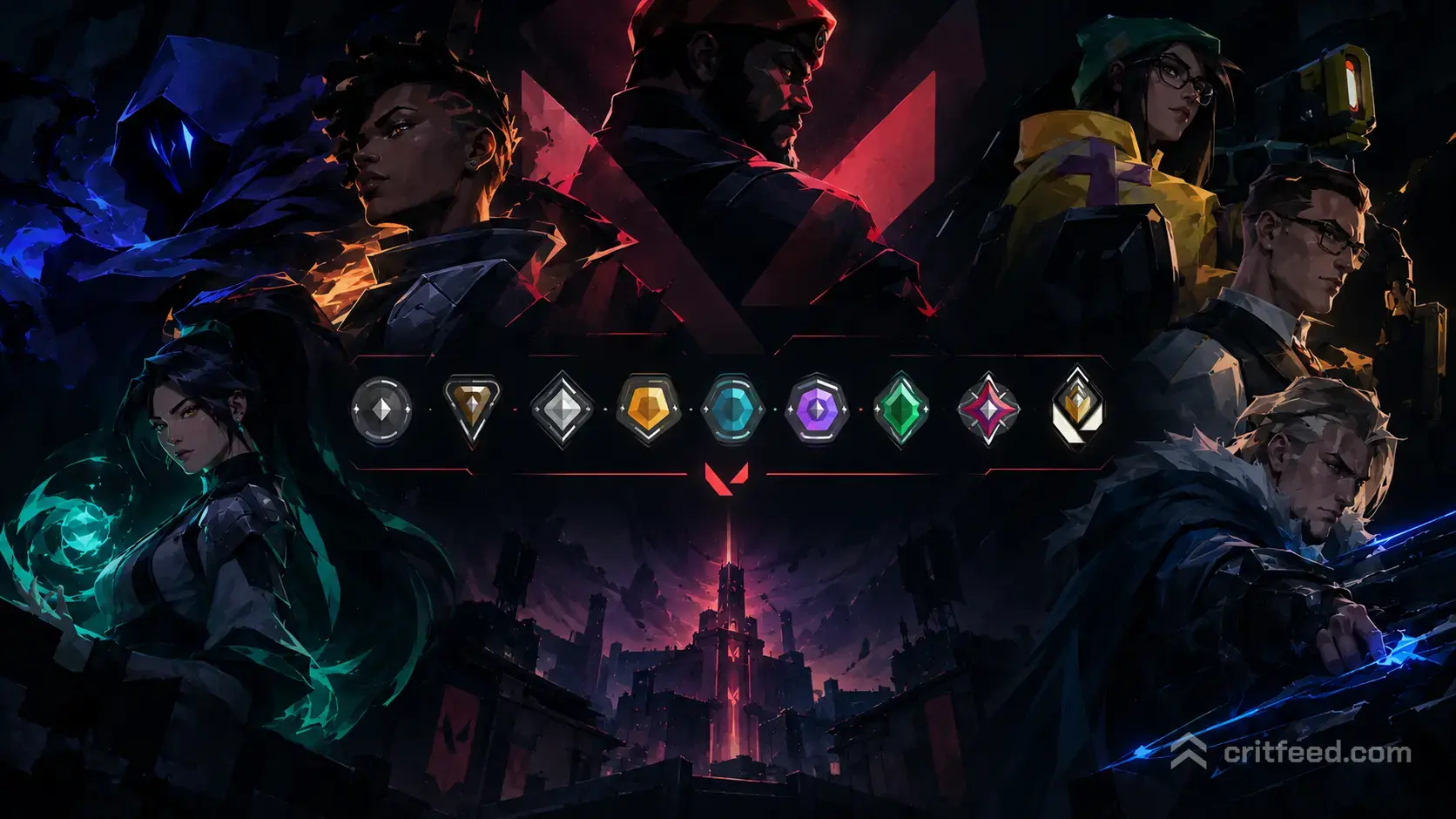
What Does RR Stand For in Valorant? Ranked Rating Explained
If you have ever ended a Competitive match and seen a number tick up next to your rank, you have met RR. What does RR stand for in Valorant? It stands for Ranked Rating, the point system Riot uses to track your climb inside every rank from Iron up to Immortal. Below, we break down how RR works, how much you gain or lose per match, and the best ways to make every game count.
What RR Means in Valorant
RR is short for Ranked Rating. It is the numeric score you earn after each Competitive match that decides whether you rank up, rank down, or stay put.
Every rank, from Iron 1 through Immortal 3, is divided into tiers worth 100 RR each. Reach 100 RR in your current tier and you promote. Drop to 0 RR and lose another match, and you demote.
Radiant is the exception. It uses a leaderboard-based RR total instead of a fixed 100-point tier, so Radiant players compete for position among the top players in their region.
How You Earn and Lose RR
RR gains and losses are driven by three things:
- Match result: wins give positive RR, losses give negative RR, draws give a small amount.
- Round differential: a 13-2 stomp pays more than a 13-11 nail-biter, and losing 11-13 costs less than losing 3-13.
- MMR vs. rank: if your hidden Matchmaking Rating is higher than your displayed rank, you gain more RR per win and lose less per loss until the two line up.
That last point is the one most players miss. Your visible rank is just the surface. The system is always nudging you toward where your Valorant matchmaking system thinks you actually belong.
Typical RR Ranges per Match
| Match outcome | Typical RR change |
|---|---|
| Win (close score) | +15 to +20 |
| Win (dominant score) | +20 to +30 |
| Draw | +3 to +5 |
| Loss (close score) | -10 to -17 |
| Loss (blowout) | -18 to -25 |
These numbers shift based on your MMR gap. New accounts and smurfs often see +30 or more per win until their MMR catches up to their rank.
Promotion, Demotion, and Protection
Hitting 100 RR in a tier promotes you to the next one. You start the new tier at a set RR floor, usually between 10 and 20 RR, so a single bad loss will not immediately send you back.
Demotion triggers when you hit 0 RR and then lose another ranked match. You drop into the tier below with around 80 RR, giving you a chance to climb back without starting from scratch.
Riot also runs a soft demotion protection window right after you rank up. Lose the first game or two in your new tier and you will not immediately be dropped back down, though repeated losses will still demote you eventually.
Does Individual Performance Affect RR?
Yes, but less than it used to in the lower ranks and almost not at all in the higher ones.
- Iron through Ascendant: performance bonuses or penalties can swing your RR by a few points. A great scoreline on a loss cushions the damage. A poor scoreline on a win trims your gain.
- Immortal and Radiant: performance has minimal impact. Wins and losses are what move the needle, which is why these ranks reward consistent round-winning over flashy stat lines.
The lesson is simple: the system rewards winning rounds. Padding kills on a loss will not save your RR nearly as much as closing out one more round.
Rank Decay and Immortal+ Rules
At Immortal and Radiant, inactivity costs you. If you do not play Competitive for an extended period, your RR starts bleeding off to keep the leaderboard honest. Lower ranks do not decay, so Diamond and below can take a break without penalty.
Each new Act also brings a soft reset. You keep most of your progress but need to play five placement matches, and your starting rank is typically one to two tiers below where you finished. For the full schedule and what changes in each refresh, check our breakdown of the latest Valorant Act.
How to Gain RR Faster
If you want to climb instead of just maintain, focus on things that directly move the RR needle:
- Win rounds, not just fights. Trade kills, play for the Spike, and respect the economy. A thrifty round win counts the same as any other.
- Queue when you are sharp. Tilted queues cost more RR than they can ever return. One loss on tilt usually becomes three.
- Play agents you actually know. Flex picks on autofill agents lose more rounds than they win. Our full agent list is a good starting point if you want to narrow your pool.
- Fix the basics. Crosshair placement, utility usage, and comms outperform aim mechanics at every rank below Immortal. Our Valorant tips and tricks covers the habits that move win rates most.
- Review your losses. The RR you lost today is the RR you will gain back tomorrow if you figure out why you lost it.
RR in Premier vs. Competitive
Competitive RR is a solo climb. Premier uses a separate rating system tied to your team, not your personal rank, and it moves based on your team’s results across the season’s weekly matches and playoff bracket. The two systems are not linked. You can be Platinum in Competitive and run a Diamond-level Premier team, or the other way around.
VCT is a separate pro circuit entirely. Nothing you do in ranked affects pro play, and nothing pro players do in VCT changes their ranked RR.
Common RR Myths
A few things players repeat that are not true:
- “Duo queue loses more RR.” False. Duoing does not add an RR penalty on losses. Any difference comes from the RR cap on large rank gaps between duo partners.
- “Dodging only costs a flat RR fee.” The first dodge in a day is a small RR penalty, but repeat dodges stack and can cost you more than a loss would have.
- “AFK games don’t count.” They do. The system may reduce RR loss slightly for a confirmed leaver on your team, but the match still counts.
The Bottom Line
RR stands for Ranked Rating, and it is the single number that tracks every step of your Competitive climb. Wins, losses, round differential, and your hidden MMR all feed into it, with performance only mattering in a meaningful way below Ascendant.
The fastest way to climb is not to chase RR directly. Play the agents you know, win rounds instead of fights, and stop queuing the moment tilt sets in. Do that over a hundred games and the number takes care of itself.