
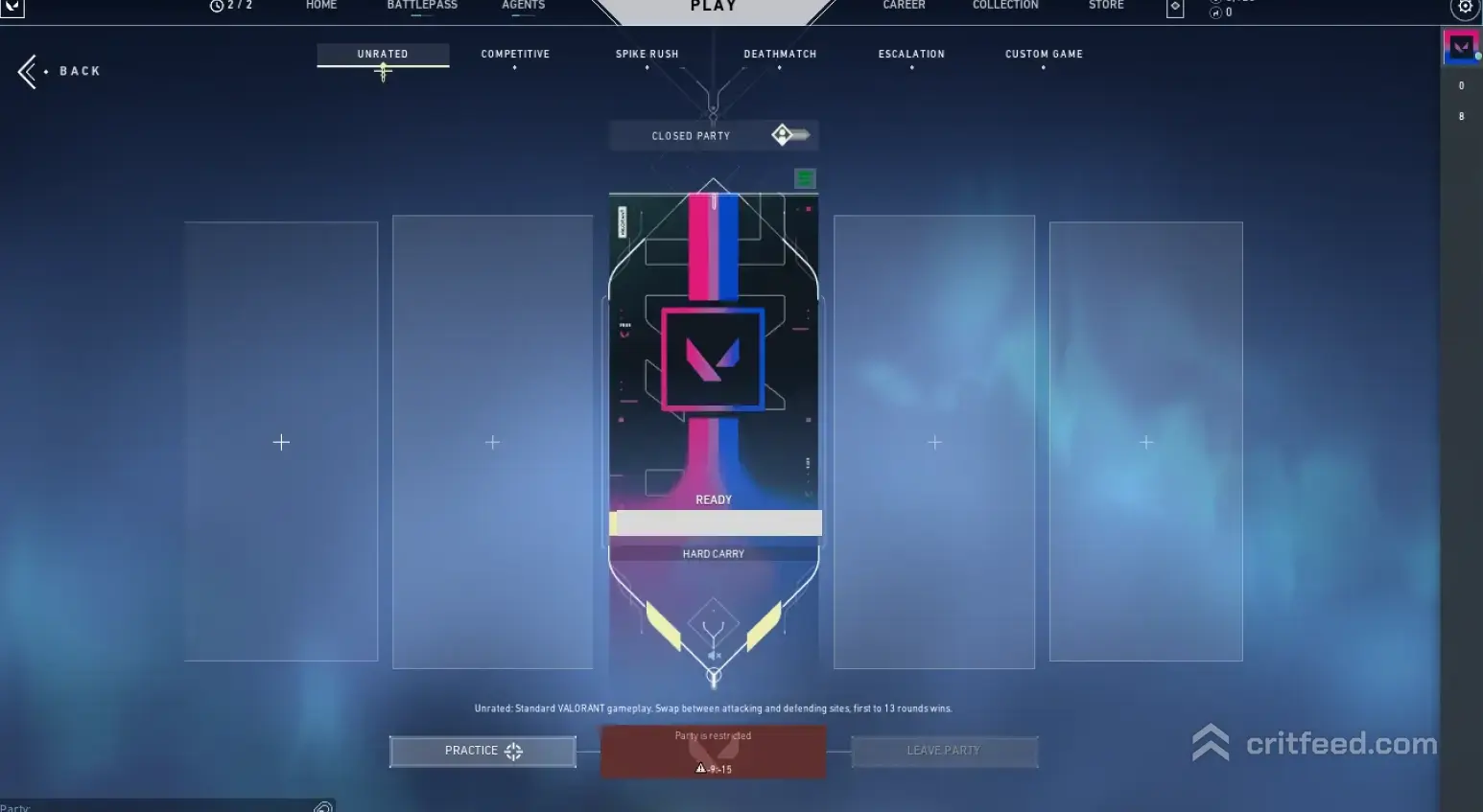
If you have ever tried to queue Competitive with a friend and gotten hit with a “rank disparity too large” error, you have run face-first into Valorant queue restrictions. These rules decide who you can play ranked with, how big your party can be, and what happens once you climb into the top tiers. Here is exactly how the system works and how to squad up without getting locked out.
What Are Valorant Queue Restrictions?
Valorant queue restrictions are the rules Riot uses to keep ranked lobbies fair. They limit how far apart teammates’ ranks can be, cap party sizes at certain tiers, and control who can queue solo, duo, or as a full five-stack.
The goal is simple: stop massive skill gaps from ruining games. A Radiant duo dragging a Bronze buddy into a match would break matchmaking for everyone in the lobby, so the game prevents it before the queue even starts.
If you are brand new to the mode, our valorant beginners guide walks through the basics before you touch ranked.
Competitive Party Rank Restrictions
In Competitive, the rank gap allowed between party members depends on where the highest-ranked player sits. The higher you climb, the stricter the rules get.
Rank Gap Rules by Tier
| Highest Party Rank | Max Rank Difference Allowed |
|---|---|
| Iron – Ascendant | Within 3 tiers |
| Immortal 1 | Within 2 tiers |
| Immortal 2 | Within 2 tiers |
| Immortal 3 | Within 1 tier |
| Radiant | Immortal 3 or Radiant only |
A “tier” here means a full rank like Silver or Gold, not the individual divisions inside it (Silver 1, Silver 2, Silver 3). So a Gold 1 player can queue with anyone from Iron through Platinum, since those all sit within three full tiers.
Unranked players are treated based on their hidden MMR. If the system thinks you belong in Diamond, you will be restricted like a Diamond player, even without a visible rank badge.
Party Size Limits in Competitive
Party size is where things get interesting. Valorant lets you queue with different group sizes, but each size has its own rules.
- Solo, Duo, Trio, or Five-stack: allowed at every rank up to Ascendant
- Four-stacks: not allowed in Competitive at any rank
- Immortal and above: five-stacks are blocked in ranked queue
The four-player ban exists because a solo player joining a pre-made group of four gets stomped on by team communication. Riot removed that queue combination years ago and has kept it out.
At Immortal+, five-stacks are also gone. Players in the top tiers can only queue solo, duo, or trio. This keeps organized teams from farming rating in matchmaking instead of playing Premier or scrims.
Immortal and Radiant Queue Restrictions
Once you hit Immortal 1, the ruleset tightens significantly.
Rating Delta System
At Immortal and above, matchmaking uses a rating number (RR points) rather than just rank tiers. Parties are only allowed if their ratings sit within a specific range of each other. If your duo partner’s rating is too far above or below yours, the queue button stays greyed out.
Solo/Duo Priority
Radiant players can only queue with other Immortal 3 or Radiant teammates. In some regions and at peak Radiant leaderboard positions, the game further restricts you to solo or duo only, since the pool of eligible players is small enough that trios cause queue times to explode.
Premier Mode Restrictions
Premier is Valorant’s team-based competitive mode, and it has its own queue rules that differ from Competitive.
- Teams need at least 5 players on the roster to play matches
- All rostered players must be in the same region
- Your Premier division is set by the highest-ranked player on the team
- You cannot swap between teams mid-week once matches begin
Premier is designed for consistent five-stacks, so the rank gap rules in Competitive do not apply the same way here. Instead, the whole team gets slotted into a division based on the top player’s rank.
For a deeper look at how the system slots players into games, check out how does valorant matchmaking work.
Why You Might Get Locked Out of Queue
Even if your party looks fine on paper, Valorant can still block you from queuing. The most common reasons include:
- Placement matches not finished: you need to complete your 5 placement games before Competitive unlocks
- Account level too low: your account must reach Level 20 to enter Competitive
- Rank decay warning at Immortal+: skipping too many days can lock certain features until you play again
- Restrictions from AFK or leaver behavior: repeated abandonment triggers matchmaking penalties
- Voice or text chat bans: severe communication penalties can block ranked entry
If a teammate is throwing games and you want to shut it down, our guide on how to mute in valorant covers the fastest way to disable comms.
Tips to Queue Ranked With Friends
If your party keeps getting flagged, here are practical ways around it.
- Check everyone’s current rank before inviting, not their peak from last Act
- Have the highest-ranked player leave first if you are trying to fit in a lower-ranked friend
- Use Unrated or Swiftplay if the gap is too large to bridge legally
- Play Premier as a full five when a member is well outside Competitive’s tier gap
- Wait for a new Act if a friend needs their rank reset by placements
Grinding placements at the start of a new Act often loosens things up, since MMR resets can push a player into a tier that suddenly makes your party legal. Our valorant new act coverage explains what changes each cycle.
Unrated, Swiftplay, and Deathmatch: No Restrictions
Good news: queue restrictions only apply to Competitive and Premier. Every other mode is open.
Unrated, Swiftplay, Spike Rush, Team Deathmatch, and standard Deathmatch let you queue with any friend at any rank. This is the workaround most players use when a friend group has too much spread to fit in ranked. If you want general improvement outside of ranked pressure, our valorant tips and tricks breakdown has drills that work in every mode.
The Bottom Line
Valorant queue restrictions are built around two things: rank gap and party size. Iron through Ascendant players can queue within three tiers, Immortal tightens to one or two tiers, and Radiant is locked to Immortal 3 or Radiant teammates only. Four-stacks are banned across the board, and Immortal+ cannot five-stack in ranked.
The exact rating deltas and party rules can shift when Riot adjusts matchmaking, so if the in-client error says something different from this page, trust the client. We will update this guide when Riot ships changes.