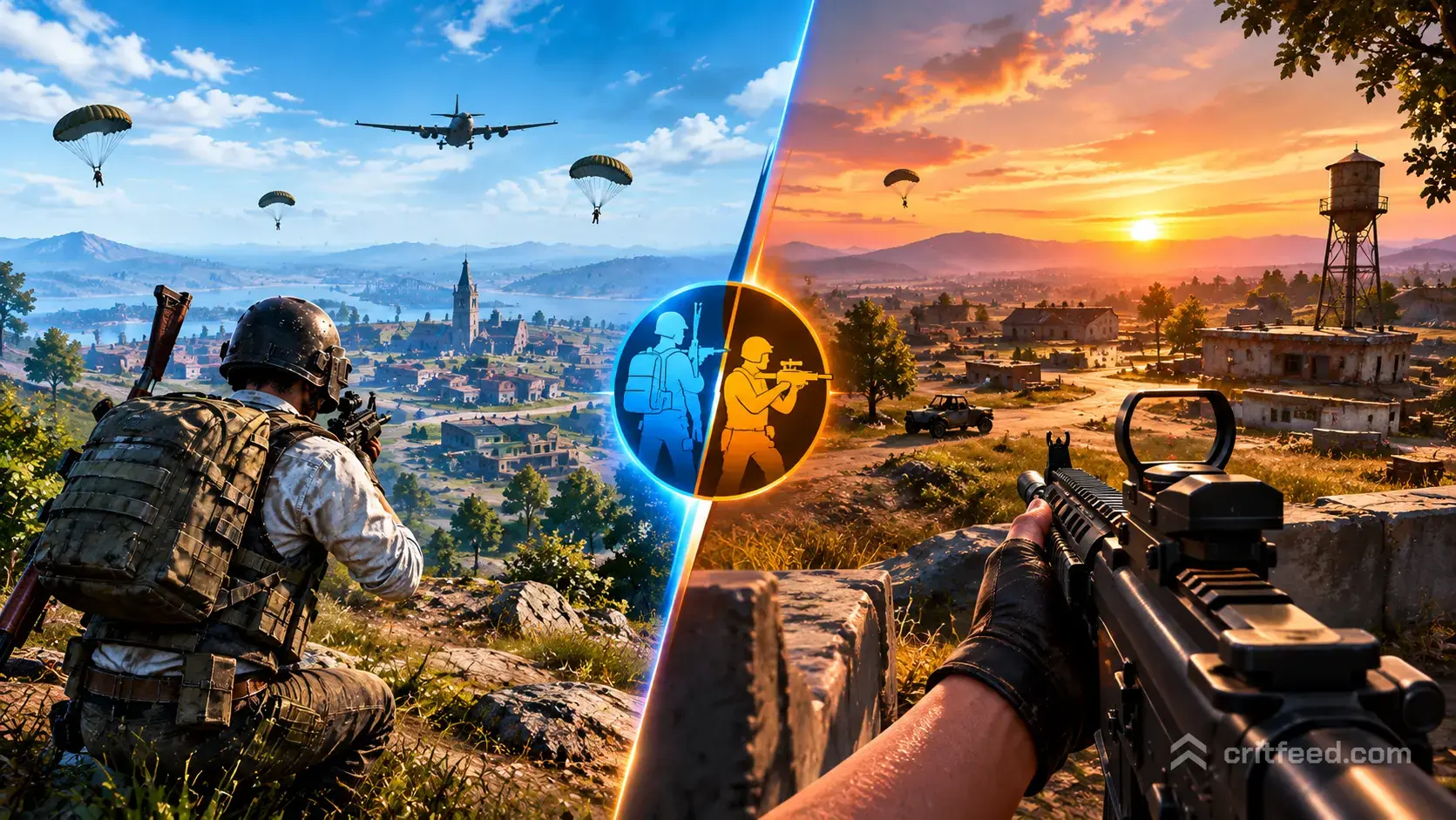
The tpp vs fpp pubg debate is the first real choice you make in Battlegrounds, and it shapes everything after. Third-Person Perspective and First-Person Perspective are not just camera options; they are two different games with their own maps of skill, tension, and pro-level meta. In this guide, we break down how each mode plays, where each one shines, and which queue fits your goals.
What TPP and FPP Actually Mean in PUBG PC
TPP (Third-Person Perspective) places the camera behind and slightly above your character. You can see your body, your backpack, and a wide arc of the world around you. Aim down sights and the game snaps to a first-person view for the shot.
FPP (First-Person Perspective) locks the camera inside your character’s eyes for the entire match. What your character can see is all you see. No peeking over walls without exposing yourself.
If you want a deeper primer on the mechanics, we cover the basics in our what is TPP and FPP in PUBG explainer.
The Core Difference: Information vs Immersion
Every argument about TPP vs FPP comes back to one trade-off.
- TPP gives you information. You can hug a wall or a rock and scan for enemies without ever showing your head. This is the infamous “third-person peek.”
- FPP gives you a level field. Nobody sees anything their character cannot see. Fights are decided by positioning, sound, and aim, not by who found the better bush first.
Bottom line: TPP rewards patience and map knowledge. FPP rewards mechanics and communication.
Gameplay Comparison Table
| Aspect | TPP | FPP |
|---|---|---|
| Camera | Behind and above character | Locked to character’s eyes |
| Peeking | Can scout around cover safely | Must expose your head to look |
| Field of view feel | Wider spatial awareness | Tunnel vision, higher immersion |
| Skill ceiling | High, driven by positioning | Higher for pure gunfights |
| Pace | Slower, more campy | Faster, more aggressive |
| Player pool (global) | Larger, more casual friendly | Smaller, more competitive |
| Vehicle driving | Easier, better sightlines | Harder, limited visibility |
Aiming and Recoil Feel Different
The moment you right-click to ADS in TPP, the game becomes FPP for that shot. That sounds simple, but it changes how you play.
- In TPP, many players hip-fire at close range because the camera already shows the target. It works, but it is less precise.
- In FPP, you learn to pre-aim corners because you cannot see around them. Your crosshair placement matters on every step.
Recoil control is identical between modes, but FPP players tend to master it faster because every fight demands it. If you want to speed up that curve, our PUBG best weapons and attachments guide breaks down which loadouts are the most forgiving.
Which Mode Is More Competitive?
FPP is the competitive standard. The PUBG Global Championship (PGC) and most major regional leagues run FPP squads. The reason is simple: FPP removes the third-person peek, so fights are decided by skill instead of by who is hiding behind the better rock.
TPP still has its own competitive scene, especially in Asia, but the biggest prize pools and the most-watched matches sit on the FPP side.
Key takeaway: If your goal is to grind ranked and eventually chase a pro path, FPP is the queue to live in.
Which Mode Is More Popular?
Globally, TPP has the larger casual player base. It is friendlier to new players because you can see your character, your surroundings, and threats without needing to expose yourself.
FPP dominates in North America and Europe among ranked and competitive players. In some Asian regions, TPP queues fill faster and matchmaking is quicker.
If matchmaking speed matters to you, check your region’s population before committing. Long FPP queues in off-peak hours are a real thing on some servers.
Map-by-Map: Does the Mode Matter?
The map you drop on changes how each perspective feels. Here is how the two modes translate across the current rotation.
Open Maps (Erangel, Miramar, Taego)
Large, open maps punish FPP players who push without cover. TPP shines here because you can pre-scan long sightlines from behind rocks and hills. If you spend most of your time on the PUBG Erangel map or the PUBG Miramar map, TPP will feel more forgiving.
Dense Maps (Sanhok, Karakin, Rondo)
Close-range maps favor FPP because fights happen inside buildings and around tight compounds. The third-person peek matters less when the enemy is five meters away. Our PUBG Sanhok map guide covers the rotation zones where FPP squads dominate.
Snow and Mixed Maps (Vikendi, Deston)
These maps blend both extremes. TPP helps with the long snowfield crossings on Vikendi. FPP helps in the vertical buildings on Deston.
Settings That Matter More in One Mode
Some settings carry more weight depending on your queue.
FPP-critical settings:
- Field of View (FOV) slider (higher FOV widens your peripheral vision)
- ADS sensitivity per scope
- Audio setup, since you rely on sound for anything you cannot see
TPP-critical settings:
- Third-person camera offset
- Aim sensitivity when snapping from third-person to ADS
- HDR and brightness for spotting from a distance
Dial these in with our best PUBG settings guide before you commit to ranked.
Pros and Cons at a Glance
TPP Pros
- Easier for new players
- Safer scouting from cover
- Better spatial awareness in vehicles
- Larger casual player pool
TPP Cons
- Camp-heavy meta
- The third-person peek can feel unfair
- Weaker competitive scene outside Asia
FPP Pros
- Fair fights, no free info from behind cover
- Faster, more aggressive pace
- The standard for PGC and top-tier events
- Sharpens raw aim and game sense
FPP Cons
- Steeper learning curve
- Smaller player base in some regions
- Harder to drive vehicles well
- Motion sickness for some players
Which Mode Should You Choose?
Pick TPP if you:
- Are new to battle royale games
- Play mostly solo or with casual friends
- Prefer methodical, positional play
- Get motion sickness in first-person games
Pick FPP if you:
- Want to climb ranked seriously
- Enjoy fast, aim-driven fights
- Watch competitive PUBG and want to play the same version the pros play
- Care about fair 1v1 duels over positional traps
There is no wrong answer. Many players run TPP for casual squads and FPP when they want a sharper challenge. If you are still learning the fundamentals, our PUBG beginner guide is the fastest way to get up to speed in either mode.
The Bottom Line
TPP and FPP are two versions of PUBG PC that share the same maps, weapons, and loot but reward completely different skills. TPP is the friendlier, more casual queue with better spatial awareness. FPP is the harder, fairer, and competitively dominant mode.
If you are just starting out, drop into TPP on Erangel and learn the map. If you want to build the skills that carry into ranked and PGC-level play, switch to FPP as soon as you are comfortable. Then keep sharpening with our PUBG tips and tricks roundup.
Whichever queue you pick, the best players in both modes have one thing in common: they made a choice and put in the reps.