
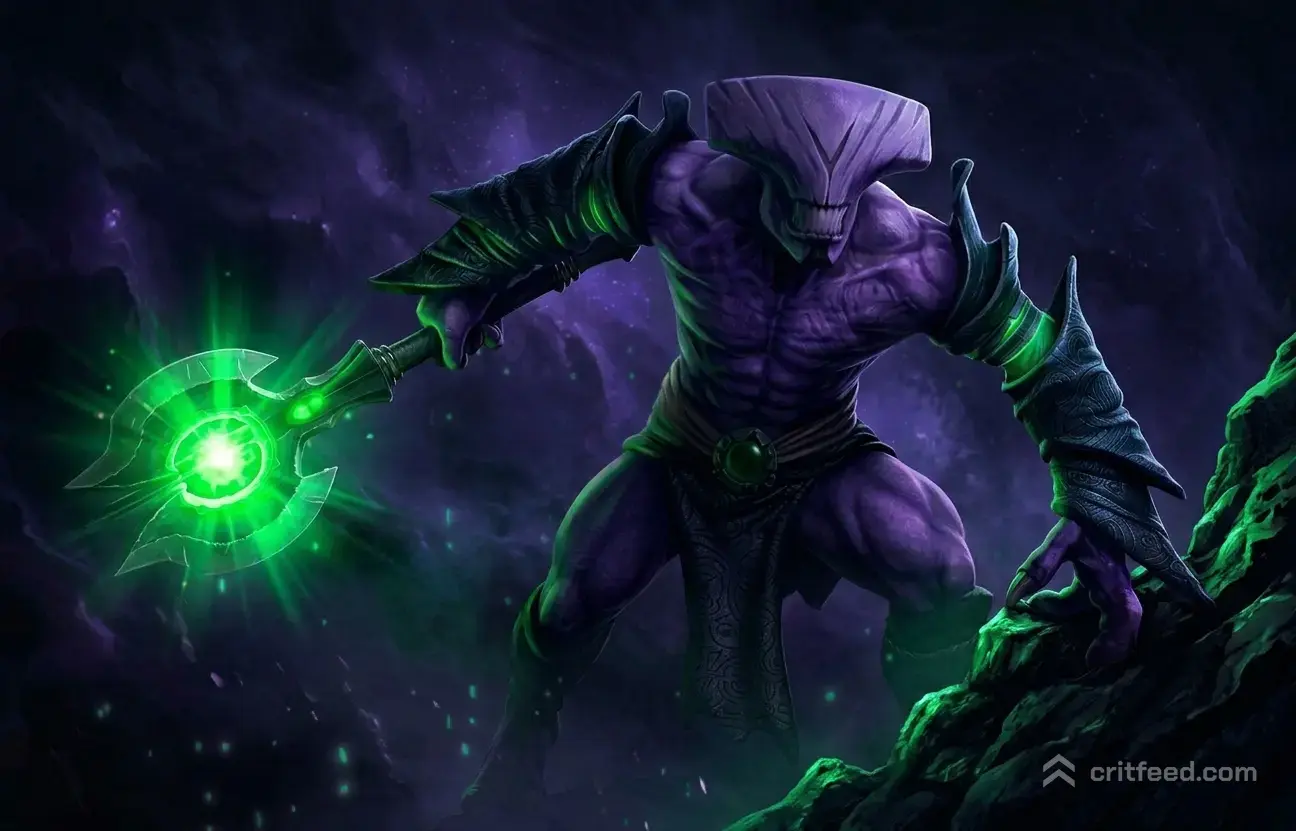
Faceless Void Guide: Master Dota 2’s Time-Bending Carry
Few heroes in Dota 2 swing a game as hard as Faceless Void. One perfect Chronosphere wins the fight, the Roshan, and sometimes the entire series. One misplaced one loses all three. We built this guide to make sure yours lands on the right side of that line.
Faceless Void, also known as Darkterror, is an Agility melee carry who sits in position 1. He is tagged as a Carry, Disabler, Durable, Escape and Initiator, which is a ridiculous spread for a single hero and the reason he has been a staple pick for over a decade.
Who Is Faceless Void?
Darkterror is a visitor from Claszureme, a dimension outside of time. In lore, every version of him exists at once, which is why his kit treats time as a toy. Mechanically, he is a late-game physical carry who scales with attack speed, crit and lifesteal, and whose teamfight ceiling is defined by one of the strongest ultimates in the game.
Core identity in one line: a melee right-click carry who freezes a bubble of time and gets a free 4.5 to 5 second kill window inside it.
Ability Breakdown
Void’s kit is small, tight, and built around his ultimate. Every other spell exists to help him land Chronosphere or survive long enough to use it.
Time Walk
Time Walk is a short-range blink that also rewinds damage taken in the last couple of seconds. That heal-back is why Void laners so often look like they are about to die, then suddenly are not. Use it to dodge projectiles like Pudge’s Meat Hook or Mirana’s Sacred Arrow, and save a charge for the escape after a fight.
Time Dilation
Time Dilation freezes all enemy cooldowns in an area and slows them. Against heroes who dumped a long cooldown ultimate, like Enigma’s Black Hole or Magnus’s Reverse Polarity, this ability can lock them out of the fight entirely. It also deals bonus damage per frozen cooldown, which quietly adds up in extended trades.
Time Lock
Time Lock is Void’s bash. It gives his attacks a chance to deal bonus damage and briefly stop the target in place. Inside Chronosphere, Time Lock procs let him chain-stun one target while the rest of the team cleans up. This is the ability that scales hardest with attack speed items.
Chronosphere
Chronosphere is the heart of the hero. Void creates a sphere that freezes every unit inside it, friend and foe, except Void himself (and anyone affected by his facet or Aghanim’s upgrades). Inside, he gets free attacks on helpless targets. Outside, your team must respect the edge of the bubble, because stepping in means getting frozen next to the enemy carry.
The hard truth: Chronosphere wins games, but it also loses them. A Chrono dropped on one hero while your team can’t follow up is often worse than no Chrono at all.
Facets and Aghanim’s Upgrades
Faceless Void has multiple facets that reshape how Chronosphere behaves and how his bashes interact with allies. Because facets and talents shift between patches, we are going to describe the direction rather than lock in numbers.
What to look for when picking a facet:
- One facet typically leans into solo-carry potential, letting Void act independently inside Chrono.
- Another leans team-fight, allowing selected allies to act inside the bubble.
- Pick based on your draft. If your team has follow-up damage like Lina or Lion, the team-fight direction usually wins. If you are the only reliable damage dealer, go solo.
Aghanim’s Scepter and Aghanim’s Shard both change how Void fights inside and around Chronosphere. Scepter traditionally expands his control inside the sphere, while Shard adds utility to Time Walk or Time Dilation. Check the in-game tooltip on the current patch before you buy either item, since Valve has rebalanced these upgrades repeatedly.
Lane Role and Starting Items
Faceless Void is almost always played as the position 1 safelane carry. He has been experimented with in the offlane and even as a position 3 initiator in pro play, but his economy demands are too heavy for anything but the farm priority role in most games.
Starting Items
A standard safelane starting kit looks like this:
| Item | Purpose |
|---|---|
| Quelling Blade | Last-hit consistency against melee creeps |
| Tango | Lane sustain |
| Healing Salve | Emergency heal, often given to your support |
| Branches x2 | Stat sticks that build into Magic Wand |
| Slippers of Agility | Early damage and attack speed |
Against hard-hitting lanes, swap one branch for a Faerie Fire for the burst-heal.
Core Item Build
Void’s build is one of the more fixed in Dota 2 because his power spikes are so clean. The debate is usually about order, not inclusion.
Early Game
- Power Treads (Agility): Attack speed, damage, and the tread-switch trick for mana on Chronosphere.
- Magic Wand: Cheap burst heal and mana against spell-heavy lanes.
- Mask of Madness: The classic Void timing. The attack speed boost turns one Chronosphere into a kill.
Mid Game
- Mjollnir or Maelstrom: Attack speed plus chain lightning, which turns Chrono into AoE execution.
- Manta Style: Dispel, illusions, and stats. Great versus silences and hexes.
- Black King Bar: Non-negotiable in most games. Chrono without BKB often ends with Void dying inside his own ultimate.
Late Game
- Butterfly: Evasion, damage, agility. Core luxury pickup.
- Satanic: Massive lifesteal and an active that heals through almost anything.
- Daedalus or Skadi: Pure damage amplification for the Chronosphere window.
The timing to internalize: Mask of Madness plus a level 6 Chronosphere is the first real power spike. Everything before that is just surviving.
How to Play the Early Game
Void’s laning is deceptive. He has mediocre base damage and no burst, but Time Walk’s damage reversal lets him trade more aggressively than he looks like he should.
- Target enemy support positioning. If a position 5 steps up for a last-hit, Time Walk in, auto-attack twice, Time Walk out. The reversal eats most of the retaliation.
- Don’t waste Time Walk charges on jukes alone. The heal is the point.
- Hit level 6 before pushing fights. A level 5 Void is a punching bag. A level 6 Void with teammates nearby is a kill threat.
The Chronosphere Playbook
A good Chronosphere is three decisions made in under a second: where to drop it, who to hit first, and what to do with the last second of its duration.
Where to Drop It
- Centered on the enemy carry and at least one support. Catching two is good, catching three is a game-winner.
- Near your BKB’d teammates. They can walk in and attack through magic immunity.
- Away from the enemy’s follow-up. If an Enigma is standing one screen away, your Chrono is a Black Hole invitation.
Target Priority Inside the Bubble
- The enemy carry if they have no BKB active.
- Any support with a game-ending ultimate on cooldown-ready (think Lion’s Finger of Death, Shadow Shaman’s Hex).
- Anyone standing on an Aegis of the Immortal.
The Last Second Rule
Spend the last second of Chrono repositioning. Click just outside the bubble so you leave with momentum, not standing still waiting for the first stun to land.
Best Teammates
Faceless Void works best with heroes who can commit damage into Chronosphere without needing to move or react.
- Invoker: Sun Strike and Cataclysm both land damage into the frozen bubble.
- Disruptor: Static Storm channels perfectly inside Chrono.
- Jakiro: Macropyre on the floor is a free execution.
- Lina: Laguna Blade on the frozen carry ends careers.
- Dark Willow: Terrorize and Bedlam both pile on without needing to click targets.
For an idea of which carries are currently competing with Void for the position 1 slot, our dota 2 hero tier list tracks the current meta.
Counters to Faceless Void
Void is strong, but he has clear weak points. If you are drafting against him, these are the levers.
Pre-6 Lane Bullies
He is slow to come online and has no ranged harass. Heroes who out-trade him in the lane crush his tempo.
- Legion Commander: Press the Attack sustain plus Overwhelming Odds damage dominates the trade.
- Phantom Assassin: Phantom Strike resets, blur dodges early auto-attacks.
- Juggernaut: Blade Fury forces Void to waste Time Walk defensively.
Chronosphere Counters
- Linken’s Sphere, Lotus Orb: Do nothing. Chronosphere is a ground-targeted spell.
- Black King Bar: Also does nothing. Chrono ignores magic immunity.
- The real counter is positioning. If the enemy team is spread across the map, you can’t catch more than one.
- Nullifier, Disperser: Dispel items on the targets Void jumps on. Chrono doesn’t dispel, but the follow-up often needs buffs that these items strip.
- Rubick: Stealing Chronosphere flips the entire teamfight.
Hard Teamfight Trumps
Heroes who out-ultimate Void win late. Enigma’s Black Hole, Tidehunter’s Ravage, and Faceless Void mirror matches all come down to who ults first and who walks away.
For a different angle on patch-driven balance changes that can shift Void’s power level, keep an eye on the kinds of issues we tracked in dota 2 patch 7.41e bugs.
Common Mistakes Faceless Void Players Make
We’ve watched a lot of Chronospheres go wrong. The same mistakes come up over and over.
- Chronoing one hero. If you can’t catch two, you probably shouldn’t ult. Save it for a Roshan contest.
- Chronoing your own carry. A frozen Spectre is not helping. Learn your team’s cores.
- Not buying BKB. A chainstun on you during Chrono erases the window.
- Over-committing in lane. Time Walk’s reversal is powerful but has a window. Trade on your terms.
- Treating Chronosphere as an engage. It’s a follow-up. Someone else should pull the trigger first.
Faceless Void in Professional Dota
Void has been a tournament staple since the earliest days of The International. His value in a drafted environment comes from the Chronosphere combo potential: coordinated teams land setups that solo-queue teams never will.
He tends to show up more in metas where the game lasts long enough for him to hit his core items, and he drops out when the meta rewards fast-paced early fighting without extended farming windows.
Watch pro replays specifically for the last second of every Chronosphere. Pros reposition inside the bubble constantly. They are not just attacking, they are setting up their exit, their next initiation, or their escape.
If you want to see another spell-caster whose cadence rewards similar timing study, our breakdown of void spirit covers a hero built around short windows of total commitment. For broader context on how systemic changes shape heroes like Darkterror, the work of icefrog remains the long arc behind every balance decision.
Behavior and Ranked Play
Faceless Void demands farm. That means communicating with your team about when you can contest fights and when you cannot. Nothing tanks a team’s winrate faster than a position 1 pinging his own supports for a 10-minute fight he had no business joining.
If you are climbing MMR on this hero, your mechanical priority should be Chronosphere accuracy, and your social priority should be clean, calm callouts. Chronosphere is a shared resource. Treating it like one keeps your dota 2 conduct summary healthy and your team willing to follow up next time.
The Bottom Line
Faceless Void is one of Dota 2’s most game-defining carries, and he is still a top-tier pick whenever the game lasts long enough for him to reach Mask of Madness, Black King Bar, and a Mjollnir or Manta. His entire kit funnels toward one four to five second window per fight, and the players who climb with him are the ones who respect how much that window costs when it’s wasted.
The single thing most Void players should fix tonight: before you cast Chronosphere, say the names of the two enemies you are catching, out loud, in voice chat. If you can’t name two, don’t ult. That one habit is worth more MMR than any item build.