
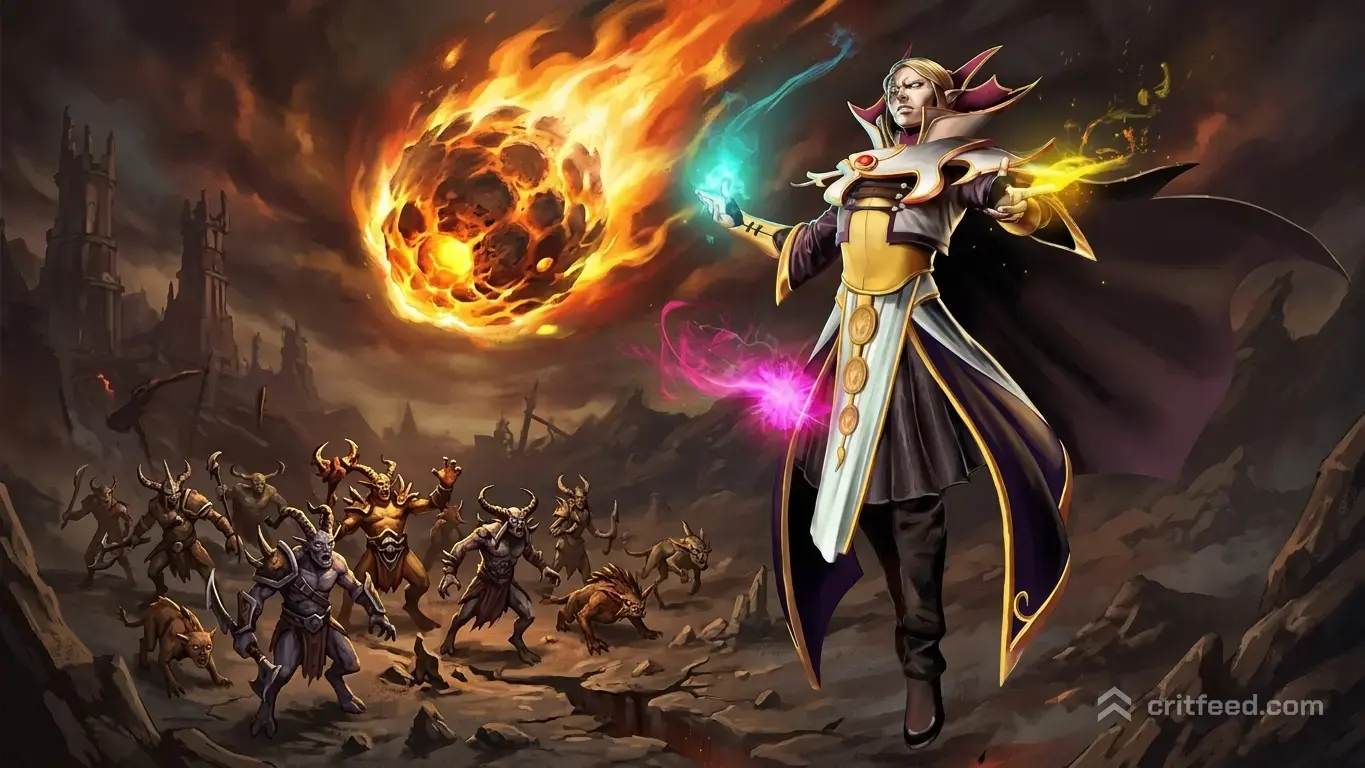
Invoker Guide: Mastering Dota 2’s 10-Spell Mid Lord
Invoker is the deepest hero in Dota 2, and the one that rewards practice more than any other. With three reagent orbs, ten invokable spells, and a kit that scales from laning bully to late-game teamfight king, Kael punishes sloppy play and rewards mechanical mastery. We’ll walk you through the fundamentals that hold up across every patch so you can start winning your lane and closing out games.
Why Invoker Is Unique
Most heroes in Dota 2 have four abilities. Invoker has three reagent orbs (Quas, Wex, and Exort) plus Invoke, and combining two instances of those orbs with Invoke produces one of ten spells. The orbs you currently have active also give passive stats, which means every point you spend changes both your spellbook and your stat line.
That design makes Invoker a hero with two personalities:
- Quas Wex (QW): An early-game roaming caster who disables, slows, and ganks lanes.
- Quas Exort (QE): A farming mid who scales into one-shot combos and massive teamfight damage.
Picking the right build for the draft matters as much as mechanics. If you’re still learning the hero pool, our dota 2 best heroes for beginners list is a better starting point. Invoker is not it.
The Three Orbs and What They Actually Do
Each orb gives passive stats per instance you have active (up to the number of points you’ve put into it), and each spell is defined by which two orbs are summoned when you cast Invoke.
| Orb | Passive stat | Theme |
|---|---|---|
| Quas | Strength and HP regen | Survival, control, slows |
| Wex | Agility and move/attack speed | Mobility, disables, utility |
| Exort | Intelligence and attack damage | Nuking, farming, burst |
The orb switch is the whole hero. You hold the orbs you need for passives, then swap to the orbs you need for a spell, cast Invoke, and swap back. Fluid orb switching is the single mechanical skill that separates good Invokers from bad ones.
The Ten Spells, Grouped by Role
You don’t need to memorize all ten on day one. Group them by what they do and learn the combos.
Damage spells
- Sun Strike (Exort x2): Global delayed nuke. Snipes low-HP heroes anywhere on the map.
- Chaos Meteor (Exort + Wex): Rolling AoE damage. Highest teamfight damage in the kit.
- Forge Spirit (Exort + Quas): Summons a ranged minion that pushes, harasses, and reduces armor.
- EMP (Wex x2): Mana burn in an area. Punishes mana-reliant cores.

Control spells
- Cold Snap (Quas x2): Short freeze that procs on every attack. The best 1v1 lane kill tool.
- Ice Wall (Quas + Exort): Line of ice that slows anyone who crosses. Devastating with allies in a choke.
- Tornado (Quas + Wex): Lifts enemies, dispels buffs, sets up Meteor.
- Deafening Blast (Quas + Wex + Exort): Knockback, damage, and disarm. Needs all three orbs.
Utility spells
- Ghost Walk (Quas + Wex): Invisibility with a self-slow. Scouting and escape.
- Alacrity (Wex + Exort): Attack speed and damage buff on an ally or yourself.
Core Combos You Must Practice
Combos win games. Here are the two every Invoker player drills in a lobby before taking the hero into ranked.
EUL Combo (Tornado -> Meteor -> Deafening Blast):
- Hold Quas + Wex, Invoke Tornado.
- Cast Tornado on the target.
- Swap to Exort + Wex, Invoke Chaos Meteor.
- Drop Meteor on the airborne target.
- Swap to Quas + Wex + Exort, Invoke Deafening Blast.
- Blast as they land. Add a Sun Strike for extra damage.
Cold Snap Combo (laning kill):
- Hold Quas + Exort, Invoke Cold Snap.
- Cast on the enemy mid.
- Right-click to proc the freeze.
- Drop Forge Spirit for extra DPS, or Sun Strike if they try to run.
The EUL combo is why Invoker needs farm. The Cold Snap combo is why Invoker wins lanes without farm.
Lane Phase: Winning Mid
Invoker’s lane depends on your build.
Quas Exort gives you free damage from Exort passives, which turns last-hitting into a non-issue. You bully with Forge Spirit, zone with its armor reduction, and set up kills with Sun Strike when the enemy is low. Your weakness is magic burst: you have no escape until you level Wex.
Quas Wex is more active. You have Cold Snap at level 2, meaning any gank from your supports becomes a guaranteed kill. You give up damage and farm speed for pressure and map impact.
Max Quas early for sustain. The HP regen from Quas instances keeps you in lane through harass. Don’t rush to level Exort or Wex to 7 before you have the Quas levels to survive.
Item Builds That Make Sense
Invoker builds are flexible, but a few items anchor every game. Check the in-game client for current gold costs and recipes before you commit.
- Boots progression: Most Invokers go Power Treads for stats and the attack speed to proc Cold Snap. Arcane Boots is a mana-starved alternative in some drafts.
- Hand of Midas: Standard on QE for farm acceleration. Skip it on QW when the game demands early pressure.
- Eul’s Scepter of Divinity: Setup for Chaos Meteor, dispel for yourself, mana regen. Core on QW, strong on QE.
- Aghanim’s Scepter: Reduces Invoke cooldown and lets you store two instances. Transforms your combo speed.
- Aghanim’s Shard: Changes how Forge Spirits work and buffs your utility toolkit.
- Octarine Core / Refresher Orb: Late-game combo pieces that let you chain EUL combos.
Reading the Draft
Invoker is a pick that answers specific drafts and gets answered by others.
Pick Invoker when:
- The enemy mid is squishy and short-ranged.
- Your team lacks AoE teamfight damage.
- You need a flex pick that can go pos 1 or pos 2.
Avoid Invoker when:
- The enemy has heavy early-game gap-closers who will delete you before you can combo.
- Your team already has long combo setup and no front line.
- The enemy stacks magic resistance and BKB timings that eat your damage window.
For a broader read on hero priority, our dota 2 hero tier list covers which mids are trending strong across the ladder.
Common Mistakes We See at Every Bracket
- Standing still while casting. Orb switching does not require you to stop moving. Keep moving between every spell.
- Burning Sun Strike on full-HP heroes. It’s a finisher, not an opener, unless you’re zoning the enemy out of XP range.
- Forgetting to re-Invoke. Your spells don’t stay slotted forever if you keep summoning new ones. Watch your spell slots.
- Ignoring Forge Spirits. They out-trade most mid heroes if you right-click with them. Micro matters.
- Building the same items every game. Invoker’s item flexibility is a strength. A QW rushing Midas is throwing.
Patch Awareness Without Patch Numbers
Invoker’s balance shifts often. Orb damage, Meteor cooldowns, Cold Snap durations, and Aghanim’s effects all get tuned regularly. Rather than memorizing numbers that will be wrong next month, learn the shape of the hero: when is my combo window, how much mana do I need, which orb do I hold between fights. Numbers change; shape doesn’t.
For the latest known issues on the hero and others, our write-up on dota 2 patch 7.41e bugs covers what to watch for after updates land. If you want to understand why Invoker’s design has survived this long, our icefrog profile is a good read.
Behavior and Teammates
Invoker is a hero people flame on sight. Playing him badly in ranked tanks your reputation score fast. Keep communication clean, mute if needed, and remember that your dota 2 conduct summary tracks every match. Low-priority queue is a worse teacher than any Invoker guide.
The One Thing to Take Away
If you only drill one skill, drill orb switching under pressure. The player who can Tornado-Meteor-Blast in under a second while being focused by two heroes wins every fight the player who fumbles the keybinds loses. Load a demo lobby, pick a dummy, and run the EUL combo a hundred times before your next ranked game. That hour will carry more MMR than any item build change.