
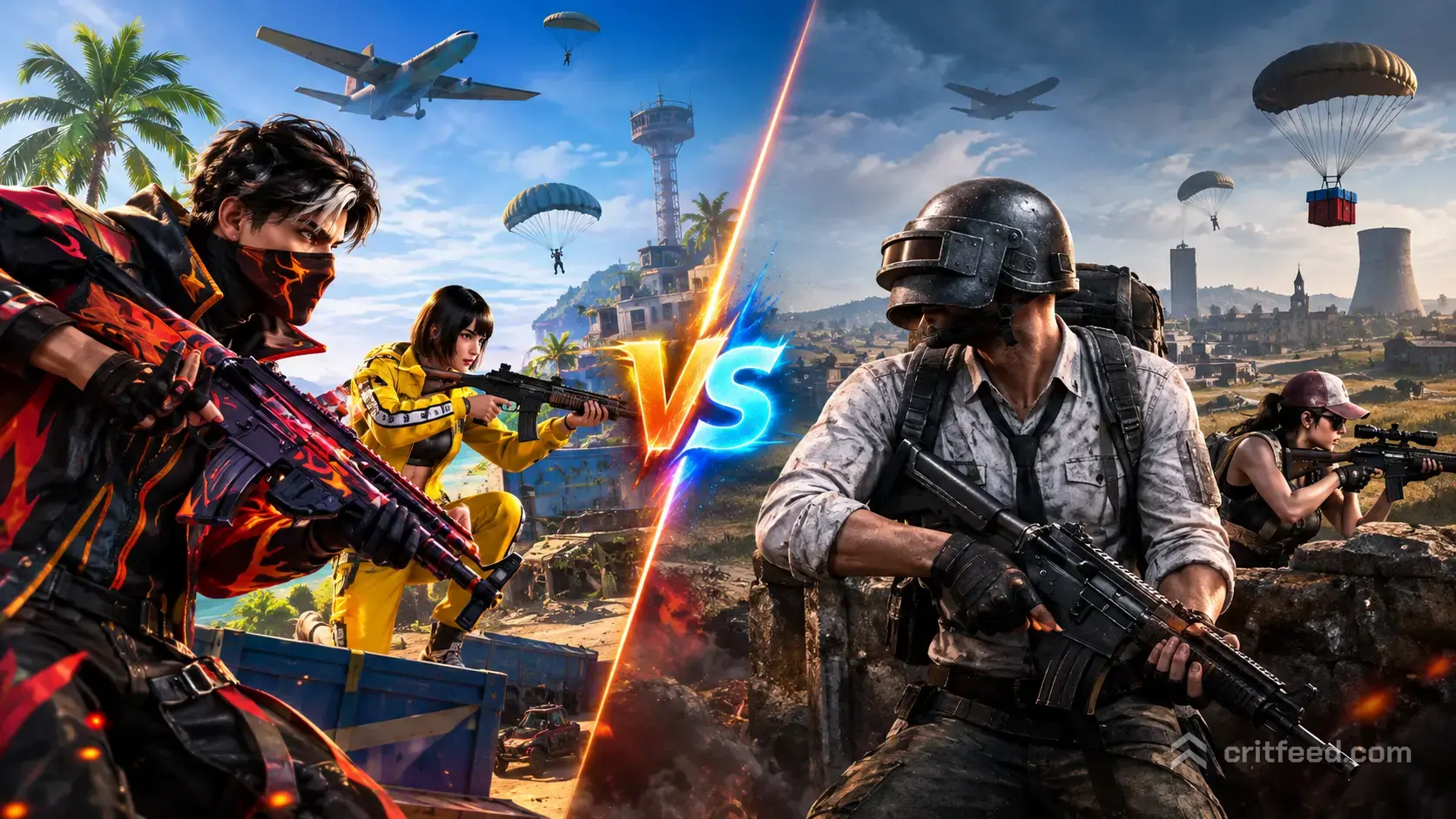
The free fire vs pubg mobile debate has followed mobile gaming for years, and the answer really comes down to your phone, your patience, and how competitive you want to get. We play both. We’ll break down the real differences — match length, lobby size, device demands, and esports — so you can pick the one that fits you.
If you’re new to the genre, our pubg mobile beginner guide is a fast way to catch up before you commit.
The Core Difference in One Line
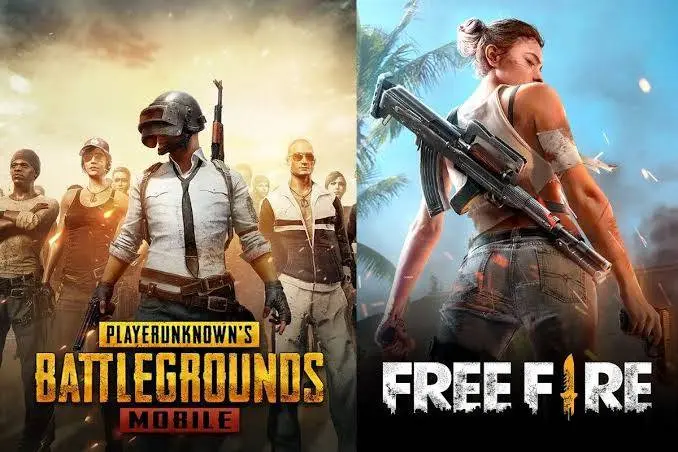
PUBG Mobile is a simulation-leaning battle royale. Free Fire is an arcade battle royale. That single split explains almost every gameplay, graphics and device gap between them.
Match Length and Lobby Size
This is the biggest gameplay gap, and it decides which game fits your schedule.
| Feature | PUBG Mobile | Free Fire |
|---|---|---|
| Players per match (Classic BR) | 100 | 50 |
| Average match length | ~25–30 minutes | ~10 minutes |
| Map size (main BR maps) | Up to 8×8 km (Erangel, Miramar) | ~4×4 km (Bermuda) |
| Perspective | TPP and FPP | TPP only |
If you get 10 minutes on a lunch break, Free Fire fits. If you want longer tactical rounds with real rotations, PUBG Mobile is the pick.
Graphics and Visuals
PUBG Mobile uses more detailed 3D models, realistic recoil animations, and higher-fidelity maps. Free Fire uses a lighter, more cartoon-style art direction so it can run on lower-end hardware.
That art style isn’t lazy — it’s a design choice that lets Free Fire hit 50-player lobbies on phones that would choke on PUBG Mobile at any decent graphic setting.
Device Requirements
This is where most players actually make their choice.
- Free Fire runs on entry-level Android phones with as little as 1–2 GB of RAM.
- PUBG Mobile wants at least 3 GB of RAM to feel smooth, and 4 GB+ for higher frame rates.
If your phone struggles, we have a lighter option: pubg mobile light is built for low-end devices. For players going the other way, our list of the best tablet for pubg mobile covers what actually holds up at high frame rates.
Gunplay and Skill Ceiling
PUBG Mobile has real recoil patterns, bullet drop on longer shots, and heavier weapon weight. You have to pull down on sprays, lead moving targets at range, and manage attachments.
Free Fire’s shooting is faster and more forgiving. Characters have active abilities and pets that alter fights, which pushes it further from a pure gunfight simulator.
Skill in PUBG Mobile leans on:
- Recoil control on ARs like the M416 and AKM
- Gyroscope aim for micro-adjustments — read our breakdown of what is gyroscope in pubg if you haven’t turned it on
- Sensitivity tuning per scope (Red Dot, 3x, 4x, 6x)
- Sound reads on footsteps and vehicles
Skill in Free Fire leans more on movement, character abilities, and short-range duels.
Controls and HUD
PUBG Mobile supports full four-finger and claw layouts, custom HUD placement, and a real gyroscope implementation. That flexibility is why competitive players can pull off jump-peeks, drop-shots, and one-tap head snaps on a 6-inch screen.
Free Fire’s controls are simpler by design. Fewer buttons, faster to learn, quicker to master at a casual level.
For anyone wanting to push the ceiling on PUBG Mobile, our pubg mobile tips and tricks covers layout choices and gyro habits worth stealing.
Maps and Modes
PUBG Mobile ships with a rotating map pool — Erangel, Miramar, Sanhok, Vikendi, Livik and Karakin — plus themed modes and Arcade queues. Free Fire’s main map is Bermuda, with a smaller pool alongside it.
PUBG Mobile also runs limited-time themed events like pubg mobile midnight hunters mode that mix new mechanics into the core BR formula.
Ranked Systems
Both games have full ranked ladders, but they scale differently. PUBG Mobile’s ranked pool spans from Bronze up to Conqueror, with tier resets each season. If you’re not sure where you land, our pubg mobile ranks explainer maps out how the ladder works and what changes at each tier.
Esports Scene
This is the cleanest gap between the two.
PUBG Mobile runs one of the largest mobile esports circuits in the world, headlined by the PUBG Mobile Global Championship (PMGC) and regional leagues that feed into it. Fans should also watch our coverage of the pubg mobile esports nations cup — a country-versus-country format that sits alongside the club circuit.
Free Fire has its own competitive scene (Free Fire World Series), but PUBG Mobile’s league system, regional depth, and prize pools are on a larger scale.
Monetization
Both games are free-to-play with cosmetic monetization. PUBG Mobile uses UC (Unknown Cash) for its store and Royale Pass. Free Fire uses Diamonds.
Neither is pay-to-win at a mechanical level — bullets don’t hit harder based on skin. If you want cosmetics without spending, we’ve written up how to get free uc in pubg mobile with legit options that won’t get your account banned.
Which One Should You Play?
Pick Free Fire if you:
- Have a lower-end phone or limited RAM
- Want quick 10-minute matches
- Prefer arcade-style shooting with character abilities
Pick PUBG Mobile if you:
- Have a mid-range or better phone/tablet
- Want realistic gunplay, longer rounds, and 100-player lobbies
- Care about esports, ranked climbs, and gyroscope aim
Neither is objectively “better” — they’re aiming at different players. The best game is the one your phone can actually run at a stable frame rate, because a smooth 60fps match beats a laggy pretty one every time.
The Bottom Line
Free fire vs pubg mobile isn’t a fair fight — they’re different genres wearing the same battle royale label. PUBG Mobile is the deeper, more tactical, more competitively supported game. Free Fire is the faster, lighter, more accessible one.
If your device can handle PUBG Mobile and you enjoy longer, more strategic matches, that’s where the higher skill ceiling and bigger esports scene live. If not, Free Fire is a legitimate BR that respects your phone and your time.
Want to compare PUBG Mobile against another shooter people love to argue about? Read our full breakdown on pubg mobile vs cod mobile next.