
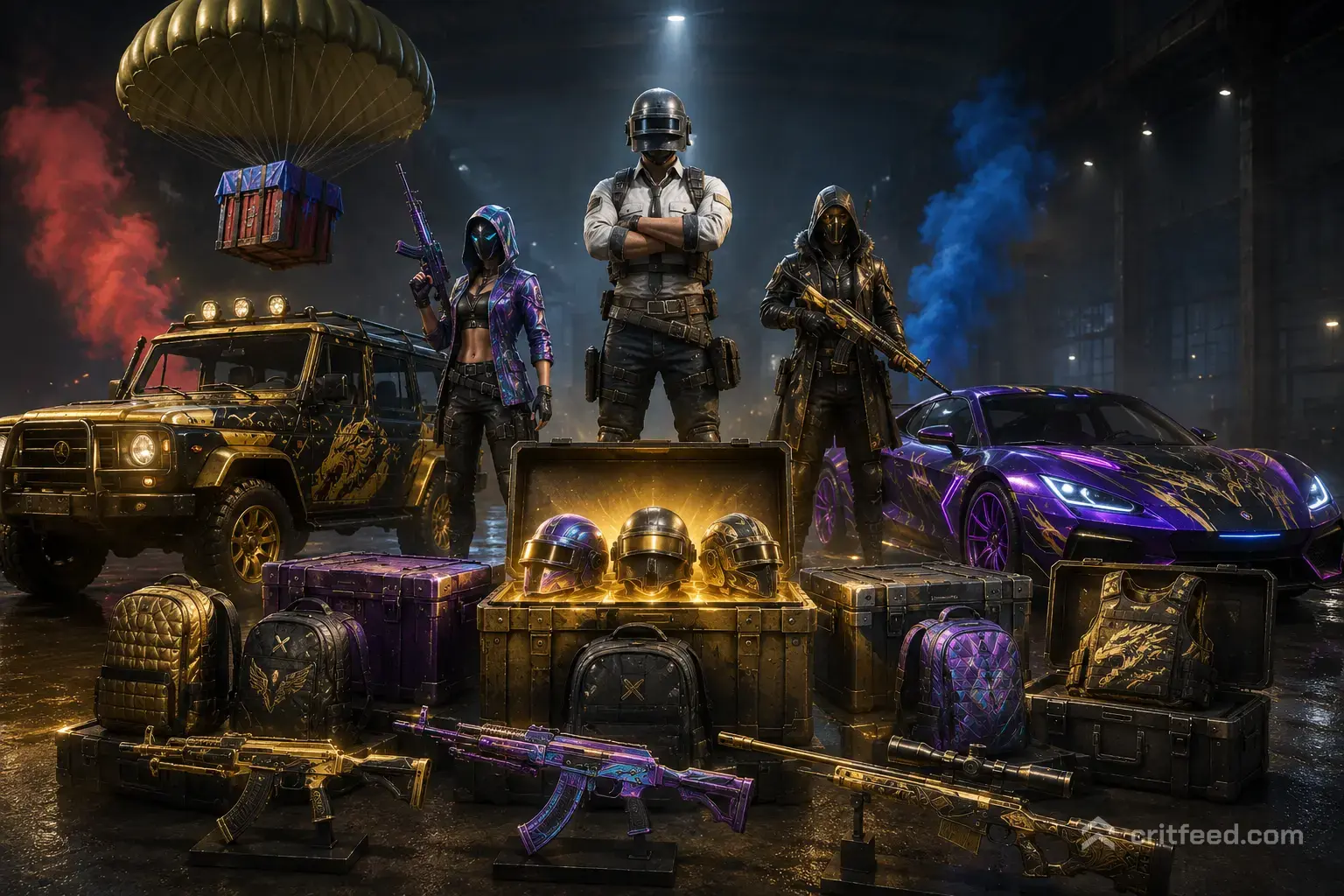
If you’re chasing that clean drip on Erangel or hunting for a specific weapon finish, PUBG skins can feel like a maze of crates, passes, stores and third-party sites. We’ll break down every legitimate way to get cosmetics on PC, what each category actually covers, and how to avoid the sketchy corners of the market.
What Counts as a PUBG Skin?
“Skin” is a loose term in PUBG: BATTLEGROUNDS. In practice, the cosmetic system covers several distinct item categories, and knowing the difference matters when you’re shopping or trading.
- Clothing — headgear, tops, bottoms, gloves, shoes, and full outfit sets
- Equipment — cosmetic backpacks, helmets, vests, and melee weapons like pans
- Weapon skins — finishes for individual guns (AKM, M416, Kar98k, and so on)
- Parachute and glider skins — visible during the drop and re-deploys
- Vehicle skins — paint jobs for UAZ, Dacia, motorcycles, and other rides
- Emotes, sprays, and nameplates — appearance items that show your identity in the lobby and in-game
Each of these has its own drop sources, rarity tiers, and — importantly — different rules around whether the item can be traded on the Steam Community Market.
Where to Get PUBG Skins Legitimately
There is no single storefront. Cosmetics come from a mix of first-party systems and player-to-player marketplaces.
1. The In-Game Store
The in-game store is the most direct route. It rotates featured bundles, individual items, and themed collections tied to whatever season is currently live. You pay with G-Coin (premium currency bought with real money) or BP (Battle Points earned in matches) depending on the item.
BP-priced items are limited and usually cosmetic basics. Most premium sets require G-Coin.
2. The Survivor Pass (Battle Pass)
Every season Krafton runs a Survivor Pass with a free track and a premium track. You unlock skins, weapon finishes, emotes, and progression rewards by completing missions and levelling up the pass.
If you play consistently during a season, the pass is usually the best value per hour of anything in the cosmetic economy.
3. Crates
Crates are PUBG’s random-drop system. You earn most crates by playing (BP purchase) or buy premium crates with G-Coin. Some crates are free-open, others require a key.
Key things to know about crates:
- Not every crate is tradable — read the item description before opening
- Some crates have weekly purchase limits
- Higher-rarity items (Elite, Mythic) sit at very low drop rates, so budget accordingly
- Crate contents rotate — items retired from a crate become harder to find later
4. The Steam Community Market
This is where the real player economy lives. Tradable weapon skins, clothing, and older crate items get bought and sold in Steam wallet currency.
Prices swing hard based on rarity, age (retired items usually appreciate), and demand for specific guns like the Kar98k, AWM, and M416.
5. Twitch Drops and Partner Events
Krafton regularly runs Twitch Drops tied to esports broadcasts like PGC and regional PUBG Global Series events. Link your Twitch account to your PUBG account, watch participating streams, and drops land in your inventory automatically.
These are free and usually include event-themed cosmetics you can’t get anywhere else.
6. Progress Missions and Login Rewards
Login streaks, seasonal missions, and free events regularly hand out low-to-mid tier skins. They’re not glamorous, but the volume adds up if you log in daily.
PUBG Skin Rarity Tiers
Cosmetics use a colour-coded rarity system similar to most looter games.
| Rarity | Colour | Typical Source |
|---|---|---|
| Common | Grey/White | BP shop, base crates |
| Uncommon | Green | Crates, low-tier pass rewards |
| Rare | Blue | Crates, pass rewards |
| Epic | Purple | Premium crates, bundles |
| Legendary | Gold | Premium crates, event bundles |
| Ultimate/Mythic | Red/Orange | High-tier crates, capstone pass rewards |
Rarity affects visual quality but not gameplay — skins in PUBG are purely cosmetic. A Legendary M416 fires the exact same rounds as a stock one.
Are Skins Tradable?
Only some are. When you preview an item, look for the “Tradable / Marketable” flag.
- Tradable + Marketable: Sell on Steam Market or trade to friends
- Tradable only: Can go to friends, but not the Market
- Untradable: Locked to your account permanently
Most Survivor Pass rewards, Twitch Drops, and event freebies are untradable. Older crate skins are the backbone of the tradable market.
Third-Party Skin Sites — Read This Before You Buy
Sites that catalogue every skin, show live prices, or offer peer-to-peer trading are common. Some are useful reference tools; others are risky.
Safer uses:
- Browsing full skin catalogues, item icons, and appearance previews
- Checking Steam Market price history before buying
Higher-risk uses:
- Buying skins off unofficial marketplaces that ask for your Steam login
- “Skin gambling” or opening sites that operate outside Steam’s trade system
- Any site asking for your account credentials directly
Stick to Steam’s own market for actual purchases. If a deal looks too good, it’s almost certainly a scam or a phishing funnel.
What Skins Are Actually Worth Buying?
This depends on how you play, but a few principles hold up:
- Weapon skins for guns you actually use beat any outfit purchase for daily satisfaction. If you’re a Kar98k main, a clean sniper finish shows up every match. Our pubg best weapons and attachments guide covers which guns get the most trigger time.
- Retired crate items tend to hold or increase value if you care about resale later.
- Full outfit sets matter mainly for lobby aesthetics — remember, in-game you’re mostly hidden by armour, backpacks, and helmets.
- Parachute skins are one of the most-seen cosmetics per match, since every round starts with a jump.
If you’re still learning the fundamentals, spend on the pass instead of one-off bundles — you’ll get more variety while you level up. Our pubg beginner guide covers the mechanics side before you drop money on cosmetics.
Skins and Competitive Play
Skins are purely visual. They don’t change hitboxes, recoil, muzzle flash, or draw distance. That said, a few practical notes for competitive squads:
- Bright outfits on green terrain like pubg erangel map or pubg sanhok map can make you easier to spot at range.
- Desert-toned sets blend better on pubg miramar map, while darker sets disappear in the snow shadows on pubg vikendi map.
- Ghillie suits are separate from cosmetic clothing and remain the strongest concealment tool — no skin replaces one.
If you want to sharpen the fundamentals your cosmetics can’t help with, our pubg tips and tricks breakdown is a solid next stop.
Common Skin Mistakes to Avoid
- Opening low-value crates with real-money keys — check the market value of the crate’s average roll first
- Trading through Discord DMs with strangers — use Steam’s trade system with a trade hold
- Buying a bundle for one item — the standalone item is often cheaper on the Market a week later
- Ignoring the “untradable” tag — you cannot recover value from these if you change your mind
- Falling for “free skin” links — these are phishing pages 100% of the time
The Bottom Line
PUBG skins in 2026 come from a mix of the in-game store, the Survivor Pass, crates, Twitch Drops, and the Steam Community Market. Cosmetics are purely visual, rarity tiers are colour-coded, and only some items can be traded — check the tag before you spend.
What we can’t tell you from memory: the exact skins in the current pass, live crate rotations, or today’s market prices. Those move constantly. Check the in-game store and Steam Market directly before making any purchase.
Once your loadout looks the way you want it, put the hours where they actually raise your win rate — map knowledge, drop routes, and gunplay. That’s what turns a good-looking squad into a chicken-dinner squad.