
Dota 2 Ranks: The Eight Competitive Tiers
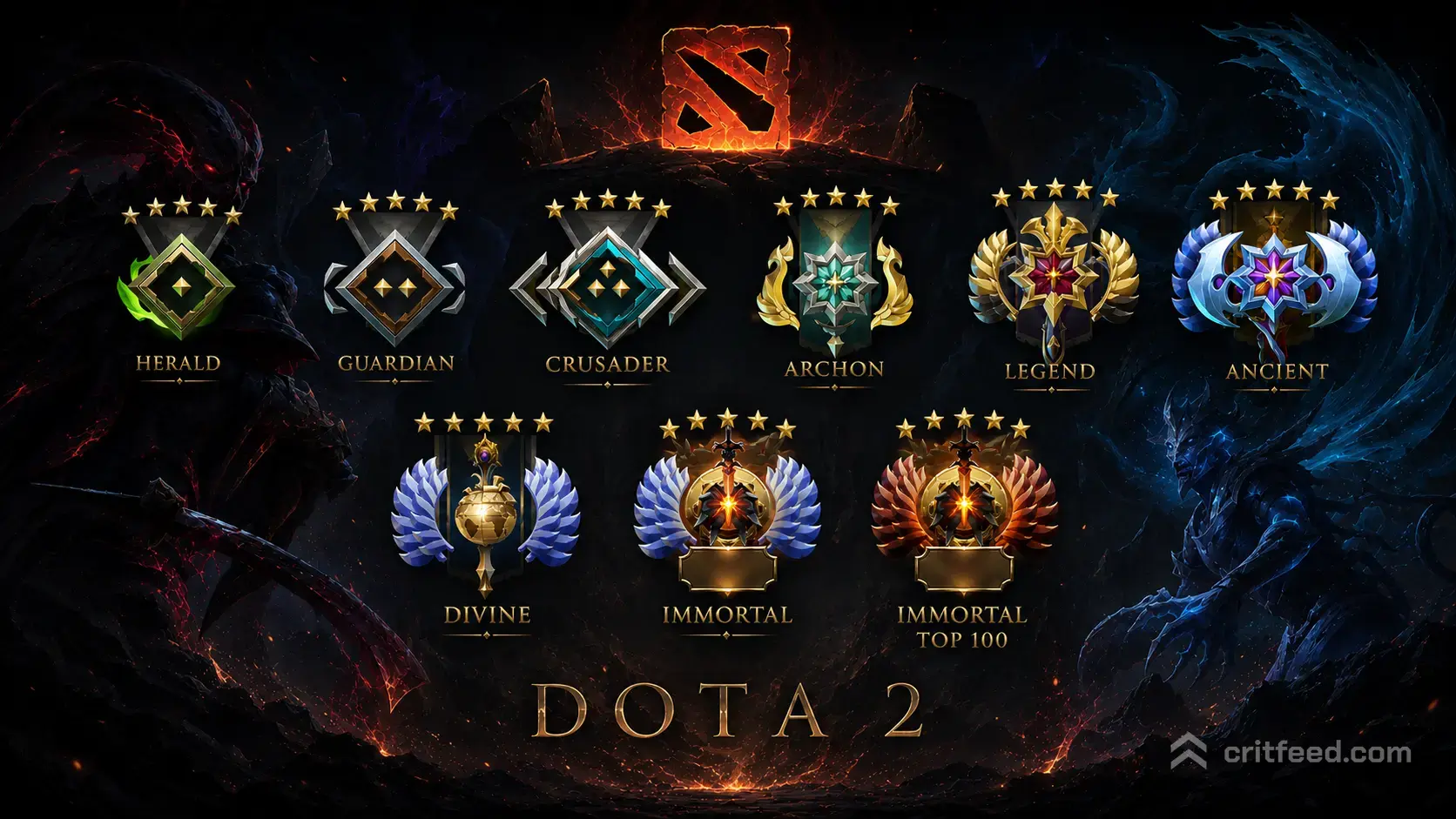
The Dota 2 matchmaking ecosystem uses an eight-tier medal structure to group players by skill, scaling from absolute beginners to the elite professional scene. According to the Esports Insider breakdown of Dota 2 ranks, this competitive ladder is built on a dynamic Matchmaking Rating (MMR) threshold. Each tier except the highest is subdivided into five stars, requiring you to consistently win matches to progress through the sub-ranks before breaking into the next major medal.
- Herald: The entry point of the Dota ranking system, where players learn fundamental mechanics like last-hitting and basic lane control.
- Guardian: Players here understand basic hero roles and item builds but still struggle with map awareness and objective priority.
- Crusader: The average skill baseline starts to form; you will see better coordination, basic warding patterns, and coordinated pushes.
- Archon: Mid-tier gameplay where players understand drafting synergy, though mechanical execution and spell positioning remain inconsistent.
- Legend: Mechanically competent players who understand smoke ganks, Roshan timings, and lane manipulation, but lack high-level macro decision-making.
- Ancient: High-tier players who optimize farming routes, respect enemy power spikes, and coordinate complex map rotations.
- Divine: The stepping stone to the elite, requiring exceptional mechanical skill, strict meta adherence, and fast reaction times.
- Immortal: The highest tier, where numerical regional leaderboards replace star ratings and matchmaking matches you against pro players.
Navigating these Dota ranks requires a deep understanding of your own playstyle and structural mistakes. In his breakdown of the system, creator BlitzSpanks provides a satirical look at what your placement on the ladder actually says about your mental state and playstyle.
To effectively climb the Dota tier system, you must focus on high-impact heroes within the current patch cycle. Progression relies on net MMR gains, meaning a standard ranked win awards roughly 25 to 30 MMR depending on whether you queued solo or in a party. Tracking your progression through the Dota 2 ranks is a matter of watching the percentage meter beneath your active medal, which reveals how close you are to earning your next star.
While the lower medals focus heavily on mechanical execution, the upper tiers of the Dota 2 ranks demand flawless team communication and immediate adaptation to enemy item choices. Simply mastering a hero’s kit will not carry you past Ancient; you must learn how to manipulate the map and force advantageous fights when your team has a net worth lead.
Dota 2 Ranks MMR: The Numerical Medal Thresholds
Dota 2 uses a baseline of 154 MMR per star. Valve’s matchmaking algorithm dynamically adjusts thresholds based on regional distribution, but the hard targets for standard dota ranks remain consistent. Mapping the exact MMR requirements across the dota 2 ranks gives you a clear trajectory for your ranked grind.
| Tier | Star 1 | Star 2 | Star 3 | Star 4 | Star 5 |
|---|---|---|---|---|---|
| Herald | 0 | 154 | 308 | 462 | 616 |
| Guardian | 770 | 924 | 1078 | 1232 | 1386 |
| Crusader | 1540 | 1694 | 1848 | 2002 | 2156 |
| Archon | 2310 | 2464 | 2618 | 2772 | 2926 |
| Legend | 3080 | 3234 | 3388 | 3542 | 3696 |
| Ancient | 3850 | 4004 | 4158 | 4312 | 4466 |
| Divine | 4620 | 4774 | 4928 | 5082 | 5236 |
| Immortal | 5620+ | – | – | – | – |
Reaching Legend 1 at 3080 MMR places you in the top 27% of active players. Ancient 1 at 3850 MMR elevates your profile to the top 16%, while entering Divine 1 at 4620 MMR filters you into the elite top 8% globally. Understanding how the dota 2 ranks scale at this upper echelon helps you gauge the distance to the leaderboard, where the star system dissolves entirely and regional ranks take over.
The current dota ranking system relies heavily on rank confidence. Your rank confidence must reach at least 30% through active matchmaking before your medal displays on your profile. If you want to know how to grow dota rank velocity under this framework, you must exploit the Glicko rating system’s high-uncertainty phases. Playing after a long hiatus or immediately following major seasonal patches yields up to 80 MMR per match instead of the standard flat 25 to 30 MMR.
Tracking your progression across these dota 2 ranks requires monitoring the percentage progress bar located directly under your medal profile. This percentage indicator only advances when your current numerical matchmaking rating exceeds the baseline threshold of your displayed star. Because the game utilizes a performance buffer, your medal won’t demote the second you drop below a threshold, but your hidden rating will decrease, forcing you to bridge the deficit before you see positive progress again.
Dota 2 Ranks Distribution: Where You Actually Fit
Evaluating where you stand on the competitive ladder requires looking at hard data rather than high-level stream perceptions. While esports coverage focuses almost entirely on the top fraction of a percent, the real competitive core is much lower. According to the Esports Tales August 2026 distribution report, the actual median of the player base sits directly at the Archon 1 and Archon 2 boundary. If your profile shows an Archon medal, you have already surpassed the bottom 50% of the active player base.
The dota 2 ranks distribution shows a classic bell curve with a heavy concentration in the middle. Crusader and Archon brackets hold almost half of all active accounts, meaning a tiny MMR gain in this region moves you past thousands of opponents. According to OpenDota’s player statistics, the transition into Legend marks the entry into the top 27% of matchmaking, while securing an Ancient medal places you in the top 12% globally. The dota tier system is notoriously bottom-heavy, keeping the Immortal elite at less than 2% of the total population.
| Rank Medal | Estimated MMR Range | Approximate Percentile | Bracket Share |
|---|---|---|---|
| Herald | 0 – 760 | Bottom 10% | 10.1% |
| Guardian | 770 – 1530 | 10% to 26% | 15.9% |
| Crusader | 1540 – 2300 | 26% to 50% | 24.0% |
| Archon | 2310 – 3070 | 50% to 73% | 23.2% |
| Legend | 3080 – 3840 | 73% to 88% | 14.8% |
| Ancient | 3850 – 4610 | 88% to 96% | 7.9% |
| Divine | 4620 – 5410 | 96% to 98.4% | 2.6% |
| Immortal | 5420 – 9500+ | Top 1.6% | 1.5% |
Breaking out of these highly congested dota 2 ranks requires a systematic approach to resources and map space. If you are struggling with how to grow dota rank through these dense mid-tier brackets, the key is macro-efficiency rather than seeking more kills. Content creator PainDota highlights that climbing through the dota ranking system requires you to consistently secure dead lanes and apply pressure to the enemy safe lane tower to force rotations. Utilizing these systematic pressure concepts is the fastest way to leave behind the average percentiles of the dota 2 ranks in 2026 and push into the top tiers.
The Peak of Matchmaking: Dota 2 Ranks Immortal and Leaderboards
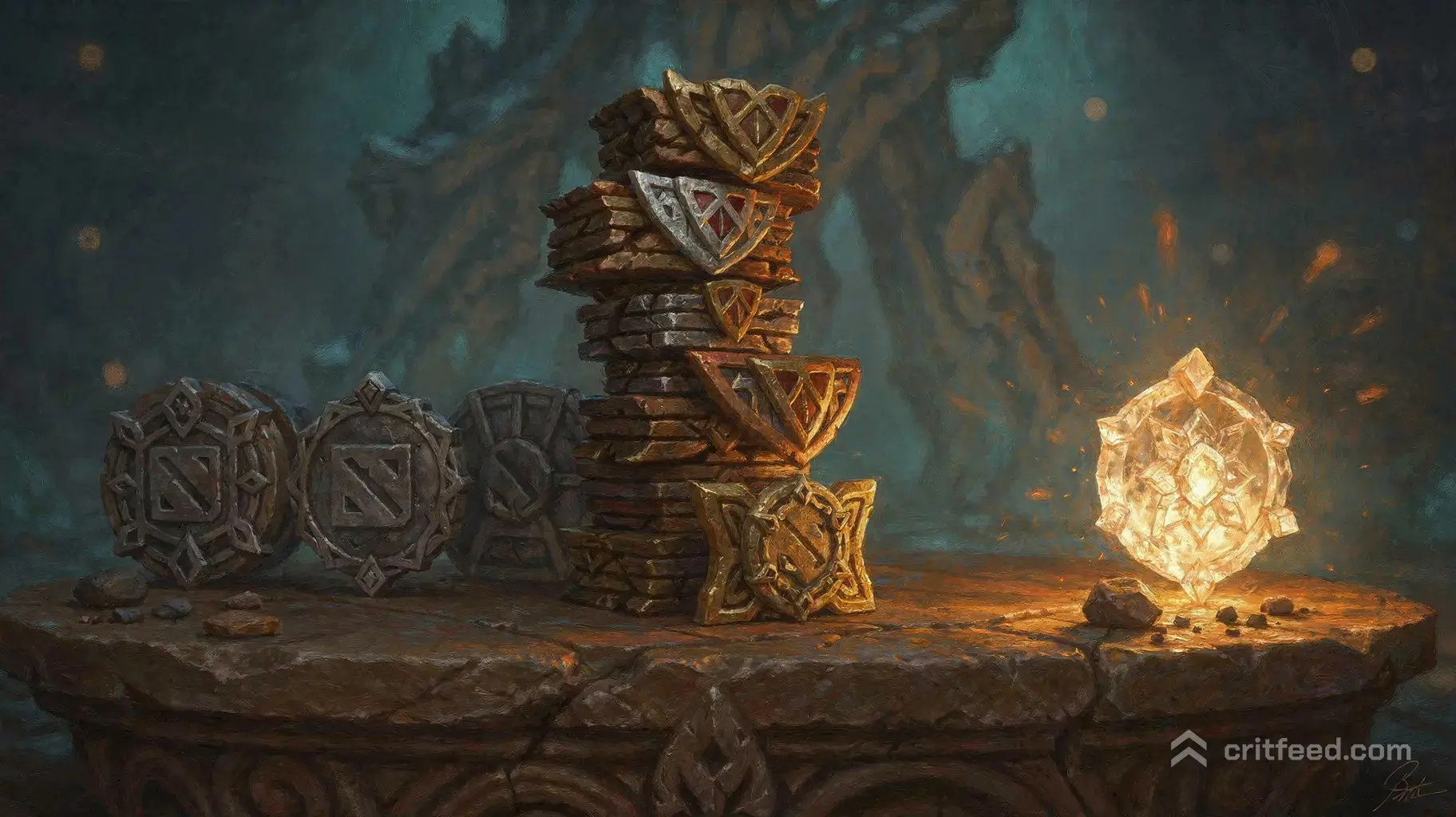
Crossing the numeric threshold into the Dota 2 ranks Immortal bracket changes how your account is graded. You leave behind the five-star sub-tier progression of Divine and lower medals. Instead, your profile displays your exact regional leaderboard placement directly on your badge, provided you rank high enough to qualify. The visual design of the badge itself shifts dynamically: standard Immortal medals feature no numbers, but as you climb, your badge gains a numeric rank, transitioning into a silver-embellished crest and eventually a golden crest for the top 100 players globally.
The official Dota 2 Leaderboards divide the global player base into four distinct regional divisions: the Americas, Europe, Southeast Asia, and China. Because the player density differs wildly, the MMR required to enter the Europe leaderboard is significantly higher than that of the Americas. To keep the competition active, these boards update multiple times each day. The top slots feature legendary accounts and pro players like bbq and Dangerboy, representing the absolute peak of competitive matchmaking.
To earn your leaderboard placement and maintain your number, you must meet strict activity requirements. Valve enforces several rules to keep inactive accounts from cluttering the regional lists, preventing players from camping their high ranks without playing:
- Play at least 21 ranked solo games within the last 21 days in the same division.
- Maintain a lifetime total of at least 100 ranked games played on your account.
- Submit and maintain your official player information via your community profile, which must match your competitive registration.
For a deeper look into these elite tiers, third-party sites like Dotabuff track the top 500 solo-queue players globally. This external leaderboard monitors recent win rates, match volumes, and preferred lanes for highly active accounts like emptiness死, letting you dissect the strategies of those with the highest MMR Dota 2 accounts.
Climbing this high alters the core matchmaking experience. Compared to the lower Dota 2 ranks, where team coordination is often chaotic and disorganized, high-MMR lobbies feature intense drafting and extreme role specialization. However, life at the top is not always perfect. Content creator BlitzSpanks highlights the issues plaguing high-level matches, including long queue times, narrow hero pools, and severe player ego clashes in his analytical breakdown.
How the Dota Ranking System Works Behind the Scenes
Valve restructured the Dota ranking system by retiring the old Elo-based calculation and implementing a modified Glicko-2 algorithm. This mathematical model evaluates your skill not just as a single static number, but as a range of potential skill levels. The system measures two primary values: your Matchmaking Rating (MMR) and your Rank Confidence. MMR represents the system’s best estimate of your skill, while Rank Confidence measures how certain the algorithm is that your current rating is accurate. The closer your Rank Confidence is to 100 percent, the less your MMR will fluctuate after each match.
When you play matches frequently, your Rank Confidence percentage increases, narrowing the margin of error the matchmaking engine applies to your profile. If you take a prolonged break from matchmaking, this confidence score decays over time. A lower confidence percentage means the system is less certain of your skill level, resulting in much larger MMR gains or losses for each match you play. This prevents inactive players who have lost their mechanical edge from ruining high-tier lobbies, while allowing returning players to quickly find their correct placement among the active Dota 2 ranks.
Recalibration is the formal process of resetting this certainty. Instead of forcing you to play a set number of placement matches at the start of a season, modern Dota 2 utilizes an ongoing recalibration toggle or triggers it automatically after extended periods of inactivity. During recalibration, the algorithm temporarily slashes your Rank Confidence back down to a low threshold. Each win or loss during this phase heavily swings your MMR, moving your medal up or down by hundreds of points per game until your Rank Confidence climbs back above 30 percent. You can track this percentage directly on your in-game profile tab to see how close you are to locking in your new medal.
This fluid calculation means there is no static number of points awarded for a win or loss anymore. Historically, you gained or lost a flat 30 MMR for solo games and 20 MMR for party games. Under the Glicko-2 system, a victory against a team with a higher average MMR when your Rank Confidence is low will net a massive rating boost, while losing to a lower-rated stack will cause a severe drop. The goal of this backend math is to push players to their deserving Dota 2 ranks as rapidly as possible, minimizing the time smurfs spend ruining lower-skill lobbies.
How to Grow Dota Rank as a Solo or Party Player
Climbing the ladder alone requires a shift in how you view resources on the map. In solo queue, your focus must remain on high-impact lanes and absolute self-reliance, as relying on uncoordinated teammates to set up complex plays is a fast way to lose MMR. Understanding how to grow dota rank in this environment means narrowing your hero pool to three meta-resilient picks per role. Spreading yourself too thin across different heroes will halt your progression through the competitive dota 2 ranks.
- Mute proactively: Do not engage with toxic teammates; mute at the first sign of typing or ping spam to preserve your mental bandwidth.
- Secure the dead lane: If your offlaner struggles, transition to farming the safe area near the enemy offlane tower to create map pressure.
- Prioritize objective-taking heroes: Pick heroes that can solo-take objectives, like Lycan, Shadow Shaman, or Nature’s Prophet, reducing your dependency on team coordination.
- Exploit lane equilibrium: Pull creeps to the hard camp or maintain the block to force the enemy offlaner into vulnerable, un-warded positions.
Party queue demands a completely different tactical framework where draft synergy and synchronized map movements overwrite raw mechanical skill. You are no longer playing five isolated games; you are executing a cohesive strategy where timing windows must be hit down to the second. To bypass plateaus in the dota 2 ranks, your stack must coordinate item timings like Crimson Guard or Pipe of Insight to force early team fights before the enemy carries can recover.
For a structural breakdown of this climb, content creator PainDota outlines a highly efficient blueprint for scaling the ladder from scratch in his comprehensive guide. His approach emphasizes fundamentals over flashy mechanical outplays, making it highly applicable to players stuck in the mid-tier brackets.
- Establish designated shot-callers: Separate the early-game macro caller (usually the position 4 or 5) from the late-game target selector (position 1 or 2).
- Draft for lane synergy: Do not pick passive lanes; pair strong setups like Grimstroke with high-damage physical cores to dominate the offlane.
- Coordinate smoke rotations: Use Smoke of Deceit immediately when your midlaner hits their level 6 power spike or when an active rune spawns.
- Map out buyback management: Never initiate a high-ground push without at least two core players having buyback secured and ready.
Dota 2 MMR Ranking 2026: Top Players and Pro Tiers
The elite professional landscape in the dota 2 mmr ranking 2026 is defined by an uncompromising divide between tier-one mainstays and rising regional prospects. To secure a spot on an active roster, players must maintain an active presence at the absolute peak of the regional leaderboards. These elite competitive echelons are tracked closely by the GosuGamers Dota 2 Team Rankings, which monitor real-time roster changes, tournament performance, and the shifting power balance between the top clubs globally.
- Tier 1: Elite global tournaments, including The International and major ESL One events, dominated by players holding double-digit leaderboard dota 2 ranks.
- Tier 2: Regional leagues and mid-tier tournaments, serving as the proving grounds for tier-one academy projects and unsigned stacks.
- Tier 3: Local qualifiers and grassroots tournaments, which form the base of the professional dota tier system as defined by the Liquipedia Dota 2 Portal: Rankings.
Individual MMR peaks have surged past 15,000 and 16,000, rendering previous milestones obsolete. At these heights, matchmaking matches are highly volatile, pitting veterans against hyper-focused mechanical prodigies. Two-time TI champion Topson highlights this dynamic in his video, demonstrating what happens when an elite player with one of the highest dota 2 ranks takes on a highly-rated competitor in the mid lane.
At this level, the numerical rating is a professional resume. While team coordination and draft execution dictate LAN victories, organizations rely heavily on regional leaderboards to scout raw mechanical talent. If a player cannot consistently hold a spot in the top 50 of their respective region, they remain virtually invisible to Tier 1 organizations looking to inject new blood into their rosters. Consistent leaderboard presence is the only metric that guarantees a tryout.
Dota 2 Ranks Compared to LoL
Transitioning between the two biggest competitive MOBA titles requires calibrating your expectations of skill distribution. While League of Legends utilizes a ten-tier progression from Iron to Challenger, the Dota 2 ranks structure relies on eight primary medals, each split into five stars. Despite the visual and structural differences, both matchmaking systems group players into highly comparable skill buckets based on percentile distribution. Understanding where your skill set transfers prevents frustration when switching games.
At the bottom of the ladder, Herald represents the same entry-level mechanical baseline as League’s Iron and low Bronze. As you climb into Guardian and Crusader, you enter the high-density, average player base, which aligns directly with Silver and low Gold. Archon and Legend medals mark the transition into competent, macro-oriented play where players actively coordinate map movements, mirroring high Gold through mid-Platinum in Riot’s ecosystem.
| Dota 2 Medal | LoL Equivalent Tier | Skill Percentile |
|---|---|---|
| Herald | Iron to Bronze IV | Bottom 10% |
| Guardian | Bronze III to Silver IV | 10% to 33% |
| Crusader | Silver III to Gold IV | 33% to 56% |
| Archon | Gold III to Platinum IV | 56% to 77% |
| Legend | Platinum III to Emerald IV | 77% to 90% |
| Ancient | Emerald III to Diamond IV | 90% to 97% |
| Divine | Diamond III to Master | 97% to 99.5% |
| Immortal | Grandmaster to Challenger | Top 0.5% |
Once you push into the high-tier Dota 2 ranks, the margin for mechanical and strategic error shrinks dramatically. Ancient maps cleanly onto high Emerald and low Diamond, where players possess solid laning phase execution but still make macro mistakes during high-ground pushes. Divine represents high Diamond and low Master, where precise itemization and buyback management become win conditions. Immortal is reserved for the absolute peak, matching League’s Grandmaster and Challenger tiers where players are frequently scouted for professional play. You can analyze the complete structural mapping of these competitive tiers in the MP Higher Education guide.
Dota 2 Ranked Matchmaking FAQ
Understanding where your individual skill sits compared to the rest of the global player base requires analyzing more than just your current medal. If you want a deep technical dive into player distributions and what your specific tier actually represents, watch this breakdown by Dota 2 PowerPoints. It outlines exactly how your current standing aligns with the active matchmaking landscape.
How many hours of playtime are required to unlock ranked matchmaking?
You must accumulate 100 hours of active in-game match playtime in unranked matches to unlock the ranked queue. Time spent idling in the main menu, spectating pro matches, or playing custom arcade games does not count toward this requirement. Additionally, you must associate a unique, verified phone number with your Steam account to combat smurfing and finalize your competitive matchmaking eligibility.
Does Dota 2 have rank decay?
Dota 2 does not employ traditional decay that steadily drops your MMR over time. Instead, the Glicko matchmaking system utilizes a metric called Rank Confidence. If you do not play ranked matches for an extended period, this confidence percentage gradually falls. Once it drops below the 30% threshold, your medal is hidden, and you must play calibration matches until the system gains enough data to recalculate your position.
What are the party MMR limits for ranked matchmaking?
You cannot queue for ranked games if your party has an MMR spread greater than 2800, which equals roughly five full dota ranks of difference. Furthermore, Immortal players face special rules. Immortal players can only search for ranked games in parties of two, three, or five. If you queue in a five-man party containing any Immortal players, the system will only match you against another five-man stack.
These strict competitive rules exist to protect matchmaking integrity and minimize the impact of boosting across all skill tiers. While unranked queues allow you to bypass party constraints and practice complex hero pools without stakes, climbing the official dota ranks requires navigating these structural limitations and maintaining a consistent competitive presence.