
If you have played Dota for years, there is a good chance you have experienced the same strange feeling: you think you finally understand the game, and then Dota teaches you that you know almost nothing.
That endless learning curve is one of the reasons Dota has remained special for so long. And behind much of that journey stands one name: IceFrog.
He is one of the most influential figures in the history of Dota, yet also one of the most mysterious. Unlike many famous game developers, IceFrog has rarely sought the spotlight. His work has largely spoken for him—and what that work produced is a game that millions of players have spent years learning, mastering, abandoning, returning to, and somehow still finding new depth in.
⭐ Our IceFrog Review
Overall Rating: 9.5/10
| Category | Rating |
|---|---|
| Game Design Influence | ⭐⭐⭐⭐⭐ |
| Long-Term Vision | ⭐⭐⭐⭐⭐ |
| Gameplay Depth | ⭐⭐⭐⭐⭐ |
| Competitive Longevity | ⭐⭐⭐⭐⭐ |
| Community Impact | ⭐⭐⭐⭐⭐ |
| Innovation | ⭐⭐⭐⭐⭐ |
| Public Presence | ⭐⭐ |
| Mystery Factor | ⭐⭐⭐⭐⭐ |
Verdict: One of the most important game designers in competitive gaming history.
Who Is IceFrog?
IceFrog is the pseudonym of the developer who became the principal developer of DotA Allstars and later the key gameplay figure behind Dota 2.
But there is an important distinction: IceFrog did not create the original DotA from nothing.
The original Defense of the Ancients was created as a Warcraft III custom map by Eul. DotA Allstars subsequently evolved through the work of several developers, including Steve “Guinsoo” Feak. IceFrog eventually took over development and became the dominant creative force behind the game’s evolution.
That distinction actually makes his story more impressive.
He inherited an already fascinating custom map and helped transform it into something much larger.
From Warcraft III Mod to a Gaming Phenomenon
During the mid-2000s, IceFrog became the primary developer of DotA Allstars.
This was an era when a game could exist almost entirely through a passionate community rather than a giant studio. There wasn’t a massive publisher constantly marketing the game. There wasn’t a polished storefront experience comparable to today’s live-service games.
There was a Warcraft III custom map.
And yet, somehow, Dota became enormous.
IceFrog’s contribution during this period was extraordinary. New heroes appeared. Items changed. Abilities were redesigned. Maps evolved. Balance patches constantly changed the strategic landscape.
Players didn’t simply play Dota.
They studied Dota.
And that may be IceFrog’s greatest achievement.
The IceFrog Design Philosophy
The most impressive thing about IceFrog’s work isn’t any single hero or patch.
It’s the depth of the system.
Dota doesn’t always attempt to make every hero equal in a simple sense. Instead, it creates interactions.
One ability changes the value of another.
One item suddenly becomes powerful because of a particular matchup.
A hero that looks weak in normal games can become terrifying in the hands of the right player.
A tiny balance change can completely alter professional strategies.
This creates something that is incredibly difficult to manufacture:
a game that continues teaching its players.
You can play Dota for five years and still discover something you didn’t understand.
You can watch a professional player and realize they are seeing possibilities that you never even considered.
That is not an accident.
That’s game design.
Why Dota Still Has So Much to Learn
This is where our review of IceFrog becomes less about the individual and more about his legacy.
Think about how many games you have played for years and eventually felt that you had “figured them out.”
Dota rarely gives you that satisfaction.
Instead, it keeps asking questions.
Can you understand the matchup?
Can you manage the lane?
Can you read the map?
Can you predict the enemy?
Can you optimize your item timing?
Can you understand the patch?
Can you adapt when your favorite strategy stops working?
And even after answering all of those questions, another hundred appear.
That is why Dota has survived for so long.
Twenty Years Later, We’re Still Learning
For many players, Dota is more than a game they discovered recently.
It has been part of their lives for nearly two decades.
Some players started with Warcraft III DotA.
Then came the different DotA Allstars eras.
Then Dota 2.
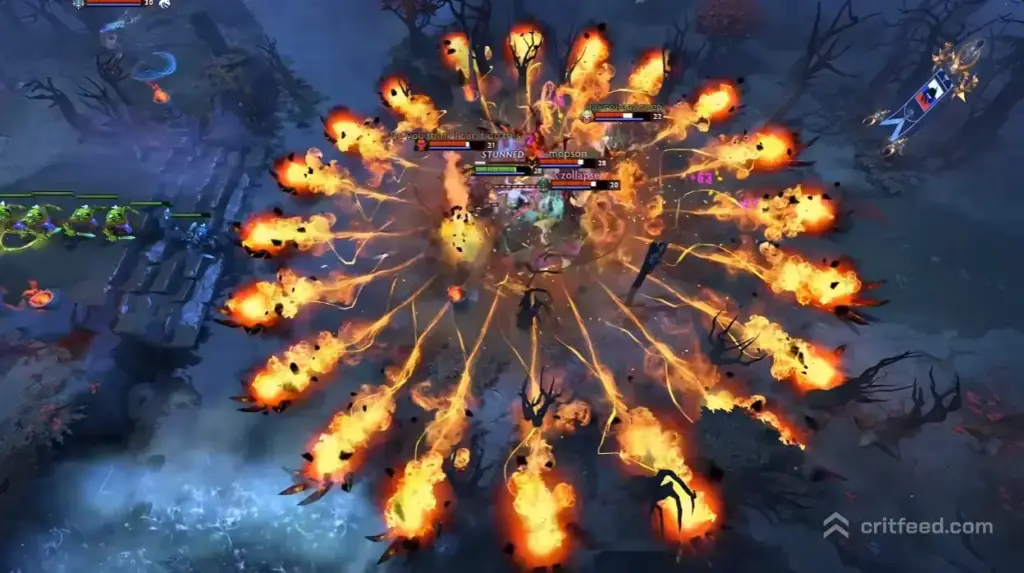
Then years of patches, hero reworks, new mechanics, new items, new maps, new metas and new strategies.
And somehow, the fundamental feeling remains:
There is still more to learn.
That is perhaps the greatest compliment IceFrog can receive.
A game that can remain intellectually interesting after decades is extraordinarily rare.
The Good, the Bad, and the Infamous Patches
Of course, reviewing IceFrog honestly doesn’t mean pretending every decision was perfect.
Dota has had its share of controversial patches.
Some changes have been celebrated.
Others have made players immediately ask:
“What were they thinking?”
And sometimes the community has had to live through bugs, balance problems and unexpected interactions while developers worked to fix them.
For example, players interested in the more chaotic side of Dota’s patch history can read our coverage of Dota 2 Patch 7.41e bugs.
That is part of the Dota experience too.
A game this complicated is going to break occasionally.
When you have thousands of interactions between heroes, abilities, items, modifiers and game systems, keeping everything perfectly predictable is an enormous challenge.
IceFrog and the Dota Community
Another fascinating part of Dota’s history is the relationship between the game and its community.
Dota players are passionate.
Sometimes very passionate.
They criticize patches.
They argue about matchmaking.
They complain about teammates.
They debate hero balance.
They celebrate discoveries.
They analyze professional games.
And they constantly try to understand whether the latest changes made Dota better or worse.
Even systems designed to improve the player experience can become controversial. For example, if you’re interested in how Dota approaches player behavior and community standards, you can also read our review of the Dota 2 Conduct Summary.
That ongoing conversation is part of what keeps Dota alive.
Our Final Review of IceFrog
So, how do you review a person whose work helped create one of the deepest competitive games ever made?
You can’t judge IceFrog purely by whether every patch was perfect.
You have to look at the bigger picture.
He helped build a game that people have played for nearly twenty years.
A game that has generated friendships.
Rivalries.
Arguments.
Professional careers.
Countless late nights.
Thousands of memorable matches.
And an almost ridiculous amount of knowledge that players continue to accumulate.
There are games you finish.
There are games you master.
And then there is Dota.
Dota keeps moving.
Thank You, IceFrog
Whatever our disagreements with individual patches may be, there is something the Dota community should never forget.
Thank you, IceFrog.
Thank you for the countless hours spent balancing heroes.
Thank you for the strange ideas that somehow became brilliant mechanics.
Thank you for the patches that forced us to rethink everything.
Thank you for the heroes that became our favorites.
Thank you for creating a game where losing can make us want to play another match immediately.
Thank you for giving generations of players something to learn together.
And most importantly, thank you for helping create a game that still doesn’t feel finished.
After almost two decades, there are still players learning new tricks.
Still players discovering new interactions.
Still players watching professional matches and thinking, “How did they even think of that?”
Still players returning after years away and realizing the game has changed again.
That is an incredible legacy.
Final Score: 9.5/10
IceFrog isn’t simply someone who worked on Dota.
He is one of the people who helped turn Dota into what it became: a game that refuses to be completely understood.
And for that, from the depths of our hearts and souls:
Thank you, IceFrog.